
Did Google just win the AI race?
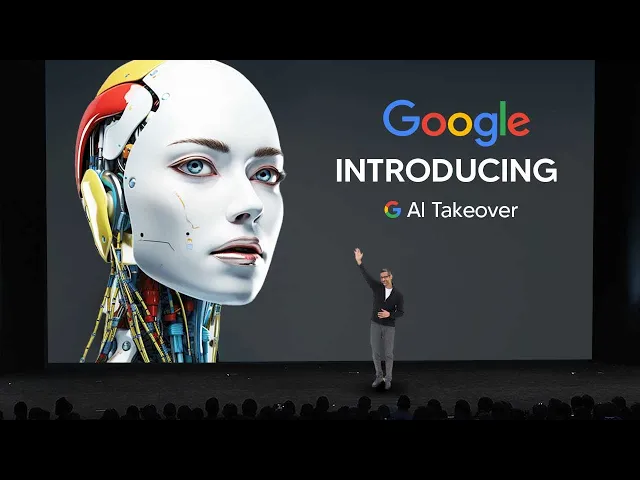
Google's AI Gemini makes a stunning debut
Google has just thrown down the gauntlet in the artificial intelligence race with its newly unveiled multimodal AI model, Gemini. After months of speculation about Google's response to competitors like OpenAI's GPT-4, the tech giant has finally revealed what may be the most capable AI system yet developed. Gemini represents not just an iterative improvement over existing models, but potentially a fundamental leap forward in how machines process and understand our world.
Key insights from Google's Gemini announcement:
-
Gemini is designed from the ground up as a multimodal AI system—capable of processing text, images, audio, and video simultaneously—unlike many competitors that added these capabilities after initial development.
-
The model comes in three sizes (Ultra, Pro, and Nano), with Ultra outperforming GPT-4 on 30 of 32 academic benchmarks and showing remarkable reasoning capabilities across multiple knowledge domains.
-
Google is rapidly deploying Gemini across its ecosystem, with the Pro version already powering Bard and the Nano version specifically engineered to run efficiently on mobile devices like the Pixel 8.
Gemini represents what appears to be a significant shift in Google's AI strategy. While the company invented the transformer architecture that powers most modern AI systems, it has seemingly played catch-up to OpenAI in recent years. With Gemini's release, Google appears to have regained technological leadership by building a truly native multimodal model rather than bolting on capabilities to existing systems.
What makes this particularly significant is how Gemini changes the competitive landscape. Unlike previous generations of AI where different systems excelled at different tasks, Gemini demonstrates superior performance across nearly all benchmark categories. From complex reasoning to creative writing to scientific problem-solving, Google's new model shows sophisticated abilities to process information across modalities in ways that more closely mirror human cognition.
The implications for business users are profound. Consider how content creation workflows might evolve with an AI that can analyze an entire marketing presentation—understanding the images, spoken narration, and text simultaneously—before offering suggestions that consider all these elements in context. This represents a qualitative improvement over current systems that often process different media types in isolation.
While Google's demo videos likely show Gemini's capabilities in the best possible light
Recent Videos
Hermes Agent Master Class
https://www.youtube.com/watch?v=R3YOGfTBcQg Welcome to the Hermes Agent Master Class — an 11-episode series taking you from zero to fully leveraging every feature of Nous Research's open-source agent. In this first episode, we install Hermes from scratch on a brand new machine with no prior skills or memory, walk through full configuration with OpenRouter, tour the most important CLI and slash commands, and run our first real task: a competitor research report on a custom children's book AI business idea. Every future episode will build on this fresh install so you can see the compounding value of the agent in real time....
Apr 29, 2026Andrej Karpathy – Outsource your thinking, but you can’t outsource your understanding
https://www.youtube.com/watch?v=96jN2OCOfLs Here's what Andrej Karpathy just figured out that everyone else is still dancing around: we're not in an era of "better models." We're in a different era of computing altogether. And the difference between understanding that and not understanding it is the difference between being a vibe coder and being an agentic engineer. Last October, Karpathy had a realization. AI didn't stop being ChatGPT-adjacent. It fundamentally shifted. Agentic coherent workflows started to actually work. And he's spent the last three months living in side projects, VB coding, exploring what's actually possible. What he found is a framework that explains...
Mar 30, 2026Andrej Karpathy on the Decade of Agents, the Limits of RL, and Why Education Is His Next Mission
A summary of key takeaways from Andrej Karpathy's conversation with Dwarkesh Patel In a wide-ranging conversation with Dwarkesh Patel, Andrej Karpathy — former head of AI at Tesla, founding member of OpenAI, and creator of some of the most popular AI educational content on the internet — shared his views on where AI is headed, what's still broken, and why he's now pouring his energy into education. Here are the key takeaways. "It's the Decade of Agents, Not the Year of Agents" Karpathy's now-famous quote is a direct pushback on industry hype. Early agents like Claude Code and Codex are...