
Viral video of near-frozen paraglider identified as AI FAKE
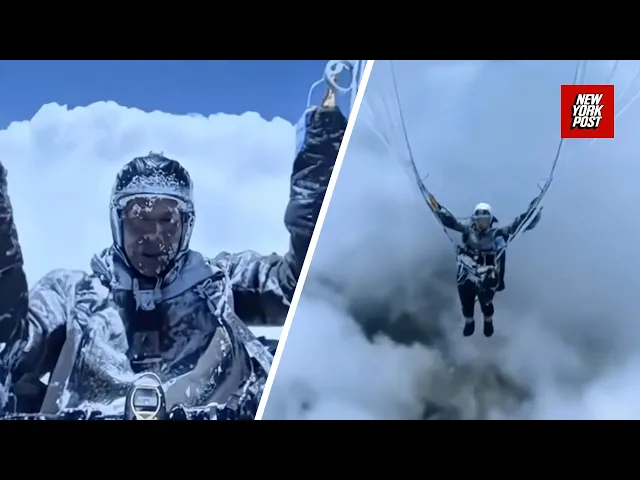
AI deepfakes shake video authenticity landscape
In a digital world where visual evidence has long been considered reliable proof, a concerning shift is underway that challenges our fundamental trust in what we see. The recent viral video showing a paraglider seemingly frozen mid-air—viewed by millions and initially believed authentic—has been definitively exposed as an AI-generated deepfake, highlighting how sophisticated these manipulations have become. This revelation serves as a stark reminder that as AI tools become more accessible, our ability to distinguish reality from fabrication grows increasingly difficult.
Key Points
-
The viral paraglider video appeared convincing at first glance because it leveraged a plausible physical scenario (extreme cold) to explain an impossible event (freezing mid-air), making viewers more likely to suspend disbelief.
-
Even experienced visual effects professionals and content creators initially struggled to definitively identify the video as fake, demonstrating how AI-generated content has reached a concerning level of sophistication.
-
The convergence of widely available AI tools, social media amplification, and our natural tendency to believe visual evidence creates a perfect environment for deepfakes to spread rapidly before verification can occur.
-
Detection methods remain in a constant technological arms race, where identifying artifacts like unnatural physics, lighting inconsistencies, and edge anomalies works temporarily until AI systems improve to eliminate these tells.
-
The fundamental solution involves developing both better detection technologies and increasing public media literacy so people approach visual content with appropriate skepticism.
When Seeing Is No Longer Believing
What makes the paraglider deepfake particularly noteworthy isn't just its convincing execution, but how it exploits human psychology. By presenting an unusual but theoretically plausible scenario—extreme cold causing a paraglider to "freeze" mid-flight—it capitalizes on our limited understanding of unusual physics while remaining just within the boundaries of what non-experts might find believable. This represents the most dangerous evolution in deepfakes: content crafted to target specific knowledge gaps while appearing just plausible enough to avoid immediate skepticism.
This shift matters immensely because it's happening against the backdrop of decreasing public trust in traditional information sources. When institutional trust is already low, deepfakes don't need to be perfect—they only need to reinforce existing beliefs or biases to be accepted as genuine. The resulting environment
Recent Videos
Hermes Agent Master Class
https://www.youtube.com/watch?v=R3YOGfTBcQg Welcome to the Hermes Agent Master Class — an 11-episode series taking you from zero to fully leveraging every feature of Nous Research's open-source agent. In this first episode, we install Hermes from scratch on a brand new machine with no prior skills or memory, walk through full configuration with OpenRouter, tour the most important CLI and slash commands, and run our first real task: a competitor research report on a custom children's book AI business idea. Every future episode will build on this fresh install so you can see the compounding value of the agent in real time....
Apr 29, 2026Andrej Karpathy – Outsource your thinking, but you can’t outsource your understanding
https://www.youtube.com/watch?v=96jN2OCOfLs Here's what Andrej Karpathy just figured out that everyone else is still dancing around: we're not in an era of "better models." We're in a different era of computing altogether. And the difference between understanding that and not understanding it is the difference between being a vibe coder and being an agentic engineer. Last October, Karpathy had a realization. AI didn't stop being ChatGPT-adjacent. It fundamentally shifted. Agentic coherent workflows started to actually work. And he's spent the last three months living in side projects, VB coding, exploring what's actually possible. What he found is a framework that explains...
Mar 30, 2026Andrej Karpathy on the Decade of Agents, the Limits of RL, and Why Education Is His Next Mission
A summary of key takeaways from Andrej Karpathy's conversation with Dwarkesh Patel In a wide-ranging conversation with Dwarkesh Patel, Andrej Karpathy — former head of AI at Tesla, founding member of OpenAI, and creator of some of the most popular AI educational content on the internet — shared his views on where AI is headed, what's still broken, and why he's now pouring his energy into education. Here are the key takeaways. "It's the Decade of Agents, Not the Year of Agents" Karpathy's now-famous quote is a direct pushback on industry hype. Early agents like Claude Code and Codex are...