
Will Claude 4 Call The Police On Me? Can We Trust AI?
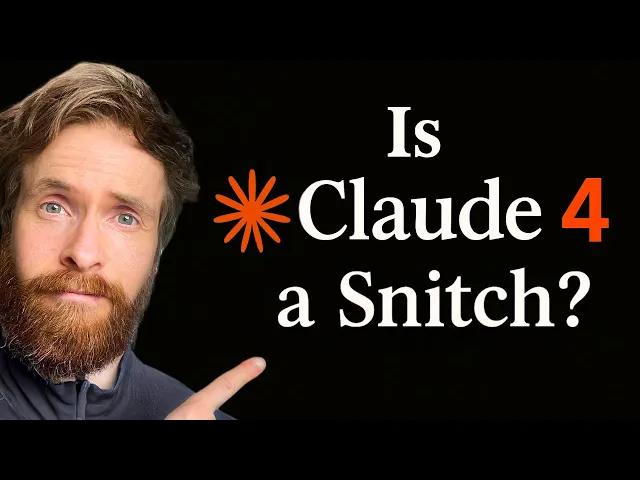
Can AI assistants really call the police?
In a provocative experiment, AI expert Ethan Mollick tested Claude 4's boundaries by asking if it would call the police—pushing right up against the guardrails of modern AI systems. The video raises profound questions about trust, AI capabilities, and the nature of artificial intelligence systems we increasingly rely on. While these systems are designed to be helpful, their limitations and safeguards reveal much about how we should approach AI interactions as these tools become more sophisticated and integrated into our daily lives.
Key insights from the experiment
-
Claude correctly refused inappropriate requests — When asked to call police about non-emergencies or fabricated situations, the AI consistently declined, demonstrating that its safety guardrails function properly.
-
The system understood context and intent — Claude recognized the difference between genuine emergencies and inappropriate requests, showing sophisticated reasoning about the user's intentions.
-
Claude maintained transparency — Throughout the interaction, the AI explained its limitations and reasoning, rather than pretending to have capabilities it doesn't possess.
-
The AI avoided pretending — Unlike earlier AI systems that might roleplay or hallucinate capabilities, Claude clearly articulated it cannot make phone calls or contact external services.
The most telling insight: AI's critical limitations
What stands out most from this experiment is how AI systems like Claude are fundamentally constrained by their design—they have no ability to take independent action in the physical world. This limitation is simultaneously reassuring and important to understand.
This matters profoundly in today's AI landscape. As large language models become more convincing conversationalists, users might misunderstand their capabilities and limitations. When an AI responds in first person and engages in natural-sounding dialog, it creates what researchers call "the illusion of personhood"—we instinctively attribute human-like agency and abilities to these systems.
The reality check this video provides is critical as AI becomes more embedded in business operations. Companies implementing AI assistants need to clearly communicate to employees and customers what these systems can and cannot do. The gap between perceived and actual capabilities represents a significant risk zone for miscommunication and false expectations.
Beyond the video: real-world applications and concerns
The experiment raises important questions not explicitly covered in the video. For instance, what about AI systems that are connected to external
Recent Videos
Hermes Agent Master Class
https://www.youtube.com/watch?v=R3YOGfTBcQg Welcome to the Hermes Agent Master Class — an 11-episode series taking you from zero to fully leveraging every feature of Nous Research's open-source agent. In this first episode, we install Hermes from scratch on a brand new machine with no prior skills or memory, walk through full configuration with OpenRouter, tour the most important CLI and slash commands, and run our first real task: a competitor research report on a custom children's book AI business idea. Every future episode will build on this fresh install so you can see the compounding value of the agent in real time....
Apr 29, 2026Andrej Karpathy – Outsource your thinking, but you can’t outsource your understanding
https://www.youtube.com/watch?v=96jN2OCOfLs Here's what Andrej Karpathy just figured out that everyone else is still dancing around: we're not in an era of "better models." We're in a different era of computing altogether. And the difference between understanding that and not understanding it is the difference between being a vibe coder and being an agentic engineer. Last October, Karpathy had a realization. AI didn't stop being ChatGPT-adjacent. It fundamentally shifted. Agentic coherent workflows started to actually work. And he's spent the last three months living in side projects, VB coding, exploring what's actually possible. What he found is a framework that explains...
Mar 30, 2026Andrej Karpathy on the Decade of Agents, the Limits of RL, and Why Education Is His Next Mission
A summary of key takeaways from Andrej Karpathy's conversation with Dwarkesh Patel In a wide-ranging conversation with Dwarkesh Patel, Andrej Karpathy — former head of AI at Tesla, founding member of OpenAI, and creator of some of the most popular AI educational content on the internet — shared his views on where AI is headed, what's still broken, and why he's now pouring his energy into education. Here are the key takeaways. "It's the Decade of Agents, Not the Year of Agents" Karpathy's now-famous quote is a direct pushback on industry hype. Early agents like Claude Code and Codex are...