
Meta sets big AI advertising goals
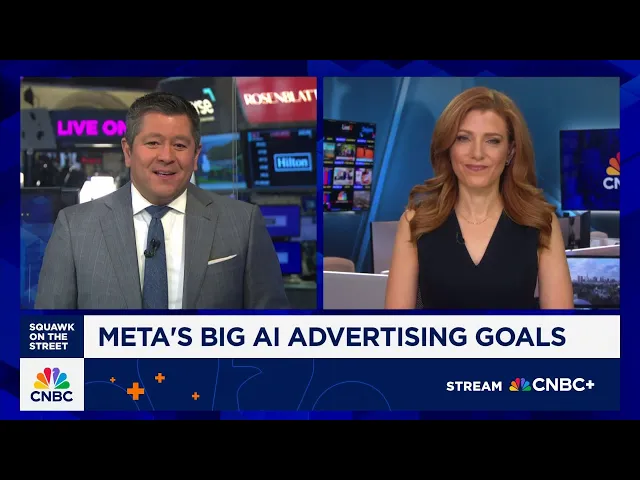
Meta bets big on AI advertising future
Meta is charging ahead with its vision to transform digital advertising through artificial intelligence, marking what could be the most significant shift in the company's business strategy since its pivot to mobile a decade ago. During Meta's latest earnings call, CEO Mark Zuckerberg and other executives outlined ambitious plans to leverage generative AI technology across their advertising ecosystem, potentially revolutionizing how businesses connect with consumers on platforms like Facebook and Instagram.
Key developments from Meta's AI advertising strategy:
- Meta is developing AI tools that will automatically generate ad creative variations, allowing advertisers to test multiple approaches simultaneously while reducing production costs
- The company plans to implement AI-powered recommendation systems that will match ads with users more effectively, potentially increasing conversion rates across its platforms
- Meta's leadership views AI advertising as crucial to future revenue growth, particularly as traditional targeting methods face challenges from privacy regulations and platform changes
The real game-changer: AI-generated advertising at scale
What stands out most from Meta's strategy is not just the implementation of AI in advertising—it's the scale and comprehensive approach they're taking. Unlike competitors making incremental AI additions, Meta is reimagining their entire advertising infrastructure around generative AI capabilities.
This matters tremendously because digital advertising has reached an inflection point. With rising customer acquisition costs, declining targeting precision due to privacy changes, and creative fatigue among users, brands need new approaches to maintain effectiveness. Meta's AI vision addresses these challenges by promising to reduce production costs while increasing personalization—essentially offering advertisers more bang for their buck in an increasingly challenging landscape.
Beyond what Meta mentioned: The hidden implications
What Meta's executives didn't fully articulate is how this shift might fundamentally alter the creative advertising industry. As AI takes over aspects of ad creation and optimization, the nature of advertising jobs will transform. Rather than disappearing, human roles will likely evolve toward becoming "AI directors"—professionals who guide AI systems with strategic and creative direction rather than executing every element manually.
This transition mirrors what we've seen in other industries transformed by automation. For example, when accounting software became ubiquitous, accountants didn't vanish; they shifted from manual bookkeeping to providing higher-level financial strategy. Similarly, advertising professionals may find themselves supervising AI systems that generate dozens of creative variations rather than producing each ad individually.
Another consideration absent from Meta
Recent Videos
Hermes Agent Master Class
https://www.youtube.com/watch?v=R3YOGfTBcQg Welcome to the Hermes Agent Master Class — an 11-episode series taking you from zero to fully leveraging every feature of Nous Research's open-source agent. In this first episode, we install Hermes from scratch on a brand new machine with no prior skills or memory, walk through full configuration with OpenRouter, tour the most important CLI and slash commands, and run our first real task: a competitor research report on a custom children's book AI business idea. Every future episode will build on this fresh install so you can see the compounding value of the agent in real time....
Apr 29, 2026Andrej Karpathy – Outsource your thinking, but you can’t outsource your understanding
https://www.youtube.com/watch?v=96jN2OCOfLs Here's what Andrej Karpathy just figured out that everyone else is still dancing around: we're not in an era of "better models." We're in a different era of computing altogether. And the difference between understanding that and not understanding it is the difference between being a vibe coder and being an agentic engineer. Last October, Karpathy had a realization. AI didn't stop being ChatGPT-adjacent. It fundamentally shifted. Agentic coherent workflows started to actually work. And he's spent the last three months living in side projects, VB coding, exploring what's actually possible. What he found is a framework that explains...
Mar 30, 2026Andrej Karpathy on the Decade of Agents, the Limits of RL, and Why Education Is His Next Mission
A summary of key takeaways from Andrej Karpathy's conversation with Dwarkesh Patel In a wide-ranging conversation with Dwarkesh Patel, Andrej Karpathy — former head of AI at Tesla, founding member of OpenAI, and creator of some of the most popular AI educational content on the internet — shared his views on where AI is headed, what's still broken, and why he's now pouring his energy into education. Here are the key takeaways. "It's the Decade of Agents, Not the Year of Agents" Karpathy's now-famous quote is a direct pushback on industry hype. Early agents like Claude Code and Codex are...