
The Agent Native Company
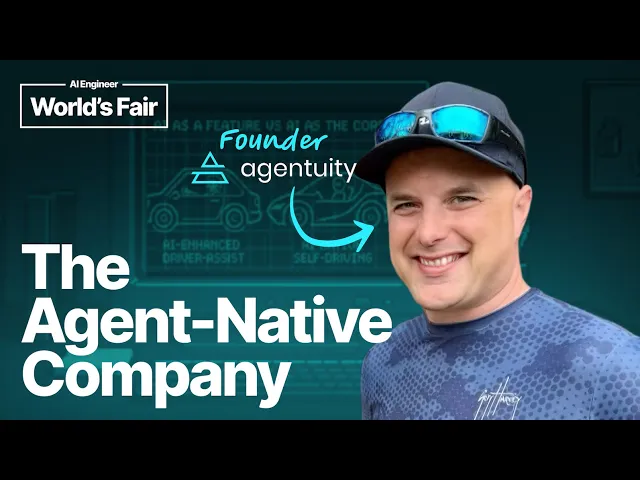
Agent native revolution is changing business
The tech world loves a good buzzword, but sometimes those buzzwords actually represent profound shifts in how we build software. In a thought-provoking conversation with Rick Blalock of Agentuity, we get a glimpse into what might be the next major evolution in software architecture: the agent-native paradigm. This approach reimagines applications as collections of autonomous agents working together, and it could fundamentally transform how businesses leverage AI.
Key insights from Rick Blalock's perspective:
-
Agent-native applications represent a fundamentally different architecture where autonomous AI agents collaborate to accomplish tasks, creating more flexible and capable systems than traditional software.
-
The shift to agent-native thinking requires reimagining software as something that proactively works on your behalf rather than tools you must manually operate—a profound change comparable to the mobile revolution.
-
Building truly agent-native companies means more than just adding AI features; it requires rethinking organizational processes, metrics, and even the fundamental business model to leverage autonomous systems.
Why agent-native matters now
The most compelling insight from Blalock's discussion is that agent-native architecture represents a paradigm shift comparable to the transitions from desktop to web and web to mobile. Each of these transitions fundamentally changed how we interact with technology, and the agent-native shift promises to be equally transformative.
This matters because businesses that recognize and adapt to this shift early will likely gain significant competitive advantages. We've seen this pattern before: companies that quickly embraced mobile-first design principles (like Uber and Instagram) displaced established players who treated mobile as just another feature. Similarly, companies that reimagine their services as agent-native systems will likely outperform those who merely bolt AI features onto existing products.
The implications extend beyond technology teams. When software becomes proactive rather than reactive, it changes customer expectations, service delivery models, and even how organizations structure their workforces. This isn't just about automating existing processes—it's about enabling entirely new capabilities and business models.
Beyond the conversation: Real-world implications
What Blalock doesn't fully explore is how agent-native approaches are already transforming specific industries. Consider healthcare, where agent systems can now continuously monitor patient data, coordinate care teams, and even predict complications before they occur. Providence Health has implemented an agent-
Recent Videos
Hermes Agent Master Class
https://www.youtube.com/watch?v=R3YOGfTBcQg Welcome to the Hermes Agent Master Class — an 11-episode series taking you from zero to fully leveraging every feature of Nous Research's open-source agent. In this first episode, we install Hermes from scratch on a brand new machine with no prior skills or memory, walk through full configuration with OpenRouter, tour the most important CLI and slash commands, and run our first real task: a competitor research report on a custom children's book AI business idea. Every future episode will build on this fresh install so you can see the compounding value of the agent in real time....
Apr 29, 2026Andrej Karpathy – Outsource your thinking, but you can’t outsource your understanding
https://www.youtube.com/watch?v=96jN2OCOfLs Here's what Andrej Karpathy just figured out that everyone else is still dancing around: we're not in an era of "better models." We're in a different era of computing altogether. And the difference between understanding that and not understanding it is the difference between being a vibe coder and being an agentic engineer. Last October, Karpathy had a realization. AI didn't stop being ChatGPT-adjacent. It fundamentally shifted. Agentic coherent workflows started to actually work. And he's spent the last three months living in side projects, VB coding, exploring what's actually possible. What he found is a framework that explains...
Mar 30, 2026Andrej Karpathy on the Decade of Agents, the Limits of RL, and Why Education Is His Next Mission
A summary of key takeaways from Andrej Karpathy's conversation with Dwarkesh Patel In a wide-ranging conversation with Dwarkesh Patel, Andrej Karpathy — former head of AI at Tesla, founding member of OpenAI, and creator of some of the most popular AI educational content on the internet — shared his views on where AI is headed, what's still broken, and why he's now pouring his energy into education. Here are the key takeaways. "It's the Decade of Agents, Not the Year of Agents" Karpathy's now-famous quote is a direct pushback on industry hype. Early agents like Claude Code and Codex are...