
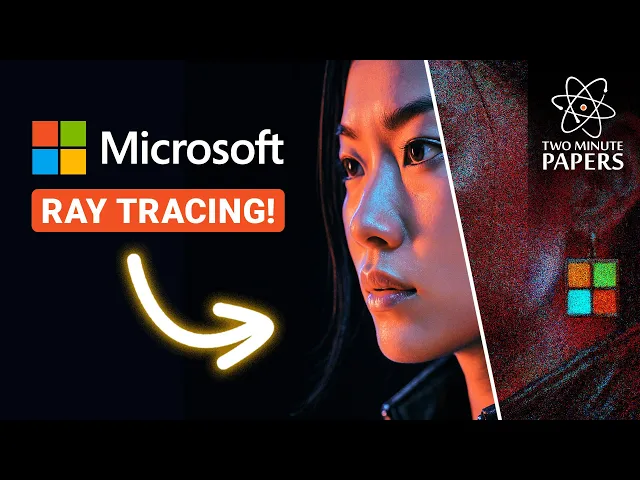
Microsoft’s New AI: Ray Tracing 16,000,000 Images!
AI image generation hits warp speed
Microsoft's recent breakthrough in AI image generation isn't just another incremental advance in a crowded field—it represents a fundamental shift in how quickly and efficiently neural networks can produce high-quality visuals. Their new model, code-named "Emu Video," can generate photorealistic imagery at unprecedented speeds by leveraging hardware innovations originally designed for an entirely different purpose: video game graphics.
Key Points
- Microsoft researchers have repurposed ray tracing technology (commonly used in gaming) to accelerate AI image generation by up to 30 times, processing an astonishing 16 million images during training
- The technical innovation involves replacing the traditional U-Net architecture with a more efficient "splatting" approach borrowed from computer graphics
- This breakthrough allows for remarkably fast image generation—creating visuals in just 0.1 seconds that would take competitors several seconds to produce
When Gaming Tech Meets AI: A Perfect Marriage
The most fascinating aspect of Microsoft's innovation is how it bridges two seemingly separate technological worlds: gaming graphics and artificial intelligence. For years, GPU manufacturers like NVIDIA have been optimizing their hardware for ray tracing—a rendering technique that calculates the precise path of light to create photorealistic reflections and shadows in video games. Microsoft's research team recognized that this same technology could solve one of AI image generation's biggest bottlenecks.
This cross-pollination of technologies matters enormously in the current AI landscape. As image generation becomes increasingly integrated into creative workflows, productivity tools, and customer experiences, speed becomes not just a nice-to-have feature but a critical competitive advantage. The ability to generate images in near real-time fundamentally changes how these tools can be used in practical applications—from real-time creative collaboration to responsive customer service bots that can visualize solutions on the fly.
Beyond the Headlines: What Microsoft Didn't Tell You
While Microsoft's breakthrough is impressive, it's worth noting that the technical approach they've taken—replacing the U-Net with a graphics-inspired "splatting" technique—carries important implications beyond just speed. Traditional diffusion models like Stable Diffusion and DALL-E use an iterative process that gradually removes noise from random pixels. This approach, while effective, is inherently time-consuming and computationally expensive.
The splat
Recent Videos
Hermes Agent Master Class
https://www.youtube.com/watch?v=R3YOGfTBcQg Welcome to the Hermes Agent Master Class — an 11-episode series taking you from zero to fully leveraging every feature of Nous Research's open-source agent. In this first episode, we install Hermes from scratch on a brand new machine with no prior skills or memory, walk through full configuration with OpenRouter, tour the most important CLI and slash commands, and run our first real task: a competitor research report on a custom children's book AI business idea. Every future episode will build on this fresh install so you can see the compounding value of the agent in real time....
Apr 29, 2026Andrej Karpathy – Outsource your thinking, but you can’t outsource your understanding
https://www.youtube.com/watch?v=96jN2OCOfLs Here's what Andrej Karpathy just figured out that everyone else is still dancing around: we're not in an era of "better models." We're in a different era of computing altogether. And the difference between understanding that and not understanding it is the difference between being a vibe coder and being an agentic engineer. Last October, Karpathy had a realization. AI didn't stop being ChatGPT-adjacent. It fundamentally shifted. Agentic coherent workflows started to actually work. And he's spent the last three months living in side projects, VB coding, exploring what's actually possible. What he found is a framework that explains...
Mar 30, 2026Andrej Karpathy on the Decade of Agents, the Limits of RL, and Why Education Is His Next Mission
A summary of key takeaways from Andrej Karpathy's conversation with Dwarkesh Patel In a wide-ranging conversation with Dwarkesh Patel, Andrej Karpathy — former head of AI at Tesla, founding member of OpenAI, and creator of some of the most popular AI educational content on the internet — shared his views on where AI is headed, what's still broken, and why he's now pouring his energy into education. Here are the key takeaways. "It's the Decade of Agents, Not the Year of Agents" Karpathy's now-famous quote is a direct pushback on industry hype. Early agents like Claude Code and Codex are...