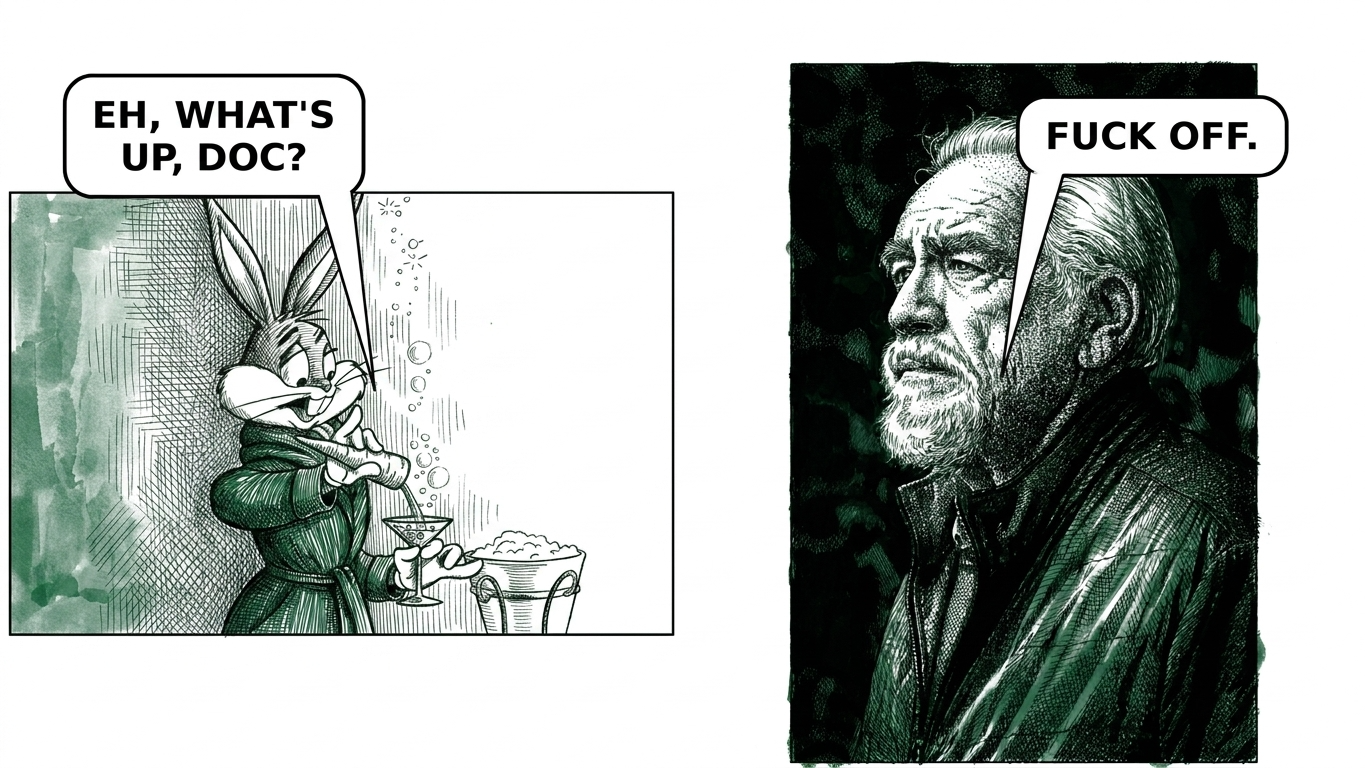

THE NUMBER: 86 years — that Bugs Bunny has been a movie star, an Academy Award winner, the face of a billion-dollar franchise, and not, at any point, a real rabbit. He debuted on July 27, 1940, in a Tex Avery short called A Wild Hare. He has appeared in more than 175 theatrical releases since. He has a star on the Hollywood Walk of Fame. He sold more war bonds during World War II than most actors who actually showed up. Every frame of him has been drawn, painted, rendered, or generated. None of it has been real. “Eh, what’s up, doc?” is the question synthetic content has been answering correctly for eighty-six years, and the audience has been answering it correctly the entire time by paying the ticket and going home humming. The Tuesday morning Google steps out at I/O 2026 with Veo 4 and Google Omni is not the moment that question gets asked. It’s the moment the answer becomes priceable. And the man who just bought the rabbit knows exactly what the answer is worth.* Confession from the cheap seats: I love the AI memes. The ones where a tabby cat busts into someone’s bedroom at three in the morning carrying a stand-up bass, sometimes with a raccoon on tenor sax and a possum on drums, the whole trio launching into a noir jazz number while the human in the bed reaches for a slipper. The French bulldog videos — Frenchies on skateboards, Frenchies as Wall Street traders, Frenchies in tiny chef’s hats sautéing onions on a clearly impossible miniature stove — the ones that pile up on Instagram and TikTok with millions of views and never, not once, have been near a real animal. I watch them on my phone in the kitchen and I laugh out loud. I know they’re AI. I do not care. They are entertaining. Bugs Bunny was entertaining in 1940. Pixar’s Woody was entertaining in 1995. The Frenchie chef is entertaining in 2026. The audience answered the synthetic-content question eighty-six years ago, and the audience keeps answering it the same way, every cycle, with the same shrug. Which means the question that actually matters — the only question that matters for the next decade — is not whether AI-generated content will work. The audience already settled that. The question is whether you, the human creator, can keep up with the AI well enough to be worth watching alongside it. That’s a much harder question. The Frenchie chef doesn’t sleep. The Frenchie chef has no agent. The Frenchie chef does not need a residual. The Frenchie chef costs pennies per second of finished video — and the price is dropping on a Moore’s-law cadence. Which means tonight’s piece goes down three rabbit holes. The first one Tomasz Tunguz dug on Friday. The second one Google opens Tuesday morning. The third one — the deepest hole, the one almost no one in the public-markets cocktail-party set has yet figured out is under the floor of the second one — is the one Larry Ellison has been digging for two years and is about to close inside of ninety days. Each hole reveals the next. Bring a flashlight.
The First Hole — Tomasz Tunguz and the First Derivative of Inference
On Friday morning, Tomasz Tunguz of Theory Ventures published The First Derivative of Inference. It is the clearest articulation we have read of where capital is actually flowing in this cycle. The fastest-growing companies in AI and software are either selling inference directly or reselling it. At worst, they are the first derivative of inference. Inference, Tunguz writes, is now the largest, fastest-growing market in technology — bigger than databases — projected to be $250 billion within seven years. Anthropic booked $9 billion and $10 billion in consecutive months. Google Cloud is growing 63% at an $80 billion run rate. And the only two pre-AI public software companies posting Tunguz-grade share-price runs are Twilio and Datadog — neither of which sells AI directly,* both of which sit one layer adjacent. “The number of spans sent to our LLM Observability product nearly tripled quarter over quarter,” said Olivier Pomel, Datadog’s CEO, on the Q1 2026 earnings call. “Six thousand five hundred customers sending data for one or more of our AI integrations — 20% of total customers, 80% of our ARR.” Twilio’s voice product is the AI-native entry point to customer service. Datadog’s observability is the meter on the inference workloads. Both companies are first derivatives of text inference. Both have been bid up accordingly. Both trades are now mostly in the price. Tunguz’s closing line is the only question that matters for any pre-AI company: “How do we either resell inference or benefit from our customers buying huge volumes of it? That’s the only way out of the Saaspocalypse.” Krishna Rao, Anthropic’s CFO, gave the same answer in different language on Invest Like the Best this past week. His existential math: “If you buy too much compute, you go out of business. If you buy too little, you can’t serve your customers. Same thing.” Rao spends 30-40% of his time on compute decisions alone. He calls compute the canvas on which everything else gets built. That’s the same sentence, on the customer side of the line, that your CFO is going to be saying about video production budgets by Halloween — except, crucially, the canvas Rao is talking about is text inference, and Tunguz’s first derivative is text inference, and the trade that has worked for two years is text inference, and the entire conversation has been about text inference. That trade is largely over. NVIDIA is at $5.47 trillion, having become the first company in history to cross $5.5T intraday this month. Twilio, Datadog, Cloudflare — bid up. The labs themselves are private and inaccessible. The Saaspocalypse Tunguz named on Friday isn’t coming. For the public-market investor, it largely happened during 2024 and 2025, and the easy money is gone. So where does the next derivative live? That’s the rabbit hole Google is about to open under the first one.
The Second Hole — Google I/O and the First Derivative of Video
Google I/O opens at Shoreline Amphitheatre at 10 a.m. Pacific Tuesday morning, May 19. The leaks already won — @mark_k pre-keynote breakdown pulled four hundred likes inside hours — and the leaks say Google ships Gemini 3.5 Flash, Gemini 3.5 Pro, Veo 4, and Google Omni in the same keynote. Omni is a multimodal video model that does blackboard math proofs, object replacement mid-video, and anime-style generation all in one conversation window. Veo 4 slots in above Sora 2 and OpenAI’s video stack. Aligned News editorial frame Sunday evening was the operator’s note: “Watch what Veo 4 delivers in the API docs. Not the keynote. The pricing sheet.” If Veo 4 prices the way the leaks suggest, video generation becomes commodity infrastructure the way text inference became commodity infrastructure in Q4 2024. Every product team ships video. Every marketing department has a video-gen line item by Q3. Every startup pitch deck has Veo 4 inside. The Tunguz logic moves one layer up the stack. The new question is: who is the Twilio of video distribution? Who is the Datadog of video observability? Who is the Adobe of video editing? Who gets crushed and who gets rich the way the text-derivative trade played out, except this time with the pixels and the soundtracks instead of the tokens and the chat completions? The cost collapse underneath this is real and the cleanest illustration of it is the Las Vegas Sphere.
The Sphere Math
The Sphere opened in September 2023, cost $2.3 billion to build, holds 17,500 seats, runs 18,600 x 13,500 pixels of programmable LED on the interior, and is wrapped in 580,000 square feet of programmable exterior display that turns the venue itself into a billboard. It is the highest-resolution venue display ever built. It is also, by every public report, programming-cost-limited. U2’s Achtung Baby residency opened the venue and ran from September 2023 through March 2024. Bono and the Edge took years to develop the visual program. Darren Aronofsky’s Postcard from Earth — the venue’s first non-concert show — was custom-shot in 18K with a proprietary camera rig and reportedly took 18 months of post-production. Industry reporting puts the per-show production budget for Sphere-grade immersive content somewhere between eight and fifty million dollars depending on complexity. The Vegas venue did roughly $1 billion in revenue in its first twelve months. Real money. The public-market read on Sphere Entertainment (NYSE: SPHR) has been skeptical for one reason: the catalog is shallow because the programming is expensive*, and Sphere Abu Dhabi, announced in 2023, doesn’t pencil without a fix for that. The fix arrives Tuesday. Run the math. A 43-minute immersive show today costs, at the low end, eight million dollars of bespoke production: dome-mapped cinematography, custom 18K rendering pipelines, six to twelve months of post, a creative team that exists in maybe four cities on Earth. Veo 4 plus a competent immersive-mapping layer — which is what private companies like Cosm and Felix & Paul Studios have been quietly building for two years — collapses that to roughly eighty thousand to one million dollars of inference and eight to twelve weeks of assembly. The cost compression is two orders of magnitude. The time compression is one. The talent-pool constraint goes away because the existing supply of people who know how to think in dome geometry — concentrated in the ~2,000 planetariums worldwide that produce fulldome content — multiplies by 100x the moment the rendering becomes generative. That changes the bookable inventory at the Sphere from “two or three residencies a year and a Vegas tourist film on loop” to thirty classic-album visual residencies a year, the entire estate-backed catalog of twentieth-century popular music as a programmable touring product. Pink Floyd’s Dark Side of the Moon. The Wall. Wish You Were Here. Animals. The Beatles’ Sgt. Pepper’s. Daft Punk’s Discovery and Random Access Memories. Radiohead’s OK Computer. Tool’s Lateralus — Tool already does this live, in concert venues, with custom visuals; the audience exists. Beyoncé’s Renaissance as a visual album. Kendrick’s DAMN. Frank Ocean’s Blonde. The Prince estate. The Michael Jackson estate. The Pink Floyd Sound Estate. Twenty to thirty bookable residencies a year, commercially viable on the Vegas venue alone, with a full slate ready for Sphere Abu Dhabi the moment it opens. That’s the franchise pipeline. That’s the cocktail-party number, and nobody is pricing it.
The Crushed
The same math runs through every industry that ships video as the primary asset. Hollywood VFX spends roughly $30 billion a year on visual effects production. The global stock photography market is roughly $4 billion. The global advertising production line item — the production cost, not the media spend — is north of $50 billion. A trillion dollars of revenue across the affected industries gets repriced inside eighteen months. Most of it is not in the share prices because most of it has not been named. Let me name some of it. A personal note on Getty Images (NYSE: GETY). Twenty years ago, running a fund, we owned Getty in size. It was, then, a brilliant business. Jonathan Klein) was running it. He had taken the company public in 1996 and was methodically rolling up the global photo-licensing market into the world’s largest digital photo library. The moat was specific and beautiful: every magazine, every newspaper, every TV station, every textbook publisher on earth needed to license images on deadline. Getty had the searchable, watermarked, lawyer-approved digital archive sitting one API call away. The moat was that digital scarcity, in 1996, was a real thing.* It worked for thirty years. Hellman & Friedman took Getty private in 2008 for $2.4 billion at the peak. Carlyle bought it from H&F in 2012. It came back public via SPAC in 2022. And then Midjourney shipped, and then DALL-E 3, and then Flux, and now Veo 4, and the moat that worked for thirty years dissolved in eighteen months. GETY trades today at $0.88. The market cap is roughly $373 million — about fifteen percent of the $2.4 billion Hellman & Friedman took it out at. The moat wasn’t bad. The moat was real. Klein didn’t misread the asset. Generative AI rewrote the cost curve of image creation by four orders of magnitude, and digital scarcity, in this one specific market, stopped being a thing. I’ll say one thing about the credit side and then move on — having spent time on the desk at one of the larger credit shops, the more honest way to express this view today is in the 14% senior notes due 2028, which the market told you what it thought of when it repriced them from the original 9.75% in the exchange offer. The liquidation value of the editorial archive is the only thing standing between Getty and a 2028 restructuring. What survives is the editorial archive — the Mahomes pick, the Aldrin photo on the moon, the breaking-news shot from the Senate floor — Veo 4 cannot generate the event that has already happened. That’s a smaller business, possibly viable at the right valuation as a carve-out. The rest of the math netted out two years ago and the share price proves it. The agency holdcos — WPP, Omnicom (OMC), IPG (IPG), Publicis — get gutted on the production line because the production line was always the synthetic part of the business. The agency’s job has been to produce broadcast-quality video and photography on a corporate timeline. Veo 4 takes that to commodity. The strategy and consulting work survives. The production work doesn’t. None of these stocks have been rewarded for three years. Adobe (NASDAQ: ADBE) is the contested call, and I’ll plant a flag rather than hedge. Adobe is the Intel of this cycle. Phenomenal distribution — Creative Cloud is in every agency, every studio, every marketing department on the planet. Firefly is competitive on the image side. Express is in the prosumer flow. Acrobat is unkillable. And the platform shifts are routing around them anyway. When Google Workspace ships Veo 4 inside Slides on Tuesday and Microsoft 365 Copilot ships its own video generation on Wednesday, the case for an average corporate marketer ever opening Premiere again gets thin. Adobe’s stock is down 25.7% year-to-date in 2026 against a market cap of roughly $99 billion. The multiples have been telling you the answer for two years. The bull-bear glass is full of exactly the same liquid, and the real question is whether $99 billion is the value-trap floor or the recovery setup. I lean trap. Intel didn’t recover for a decade.
The First Derivatives
Cloudflare (NYSE: NET) is the Twilio of video distribution. The infrastructure thesis is identical: if every product team starts shipping video, every product team needs a CDN, edge compute, image optimization, and increasingly content provenance tooling so the audience can tell which video is the real CEO and which is a Veo 4 deepfake. Cloudflare ships every one of those products and they have been the most aggressive of the public CDNs on content-authenticity work — Workers AI inference, Content Credentials initiative partnership, Web Bot Auth. NET trades at roughly $197 against a market cap of about $67 billion. That is up considerably over two years but has been volatile — the stock dropped 23.6% after Q1 2026 results, and management announced a 20% workforce reduction explicitly aimed at letting AI do the work that humans used to do. Read that move carefully: it is the Tunguz frame executed at the operator level. The CEO of an inference-derivative company is telling you, in the layoff press release, we are eating our own headcount with the technology we sell to our customers. That is not a stock to be afraid of; that is a stock where the entry price just got better. $67 billion is not a trillion-dollar company. NVIDIA hit $5.47 trillion this month. The video-derivative leg of the Cloudflare playbook is not in the price. Reddit (NYSE: RDDT) is the contrarian pick — but the honest version of it is that the text-data licensing trade on Reddit has been substantially harvested. Reddit signed an AI-data licensing deal with Google reportedly at $60 million per year; follow-on agreements with OpenAI and others. That revenue is real but it is no longer the fresh training-data trade. The labs have scraped what they can scrape from text and the marginal value of new text corpora is dropping. What Reddit is now is a humans-as-a-feature social-network bet. When the rest of the social internet floods with Veo 4 output and synthetic-influencer accounts — and it will, the same week Veo 4 ships — Reddit becomes one of the few places left where you can be reasonably sure the person on the other end of the conversation is real. RDDT trades at roughly $157, market cap about $30 billion. The platform’s product roadmap will need to converge on its high-signal half — meme subreddits get out-memed by AI; expert subs (askscience, askhistorians, AMAs with named experts) become more valuable. If the company solves that pivot, it re-rates from social-media multiple to scarce-authenticity multiple. The Bugs Bunny test cuts the platform exactly in two: the half where the audience cares whether the contributor is real, and the half where the audience doesn’t. Sphere Entertainment (NYSE: SPHR) is the cocktail-party pick. The Vegas-prototype story has been priced — SPHR is up roughly six times from its April 2023 spin-off pricing in the low twenties, trading at $134.33 against a market cap of $4.81 billion. What hasn’t been priced is the franchise re-rating. The Dark Side of the Moon math drops the programming-cost ceiling by two orders of magnitude. Vegas works. Abu Dhabi pencils. Sphere 3, 4, 5 — willing host cities, $2 billion construction budgets, a deep slate of programmable content — become a franchise pipeline. We are pricing SPHR today as a Vegas curiosity that worked. We should be pricing it the way we price a major theater chain entering its franchise phase. The pure-play exposure is messier than the elegant thesis — Sphere Entertainment also owns the MSG Networks regional sports business, which is its own carrying weight — but the direction of the call is unambiguous. A footnote on the private companies that matter to the public-market story: Cosm is the second-mover. Atlanta venue open at The Battery, Dallas in development. Founders Jeb Terry and Devin Poolman are ex-IMAX. The Cosm bet is that immersive becomes a chain at smaller scale. Cosm proves the franchise model. Felix & Paul Studios is the most likely production-pipeline acquisition target — Montreal-based, three Emmys for VR work, the most accomplished immersive content producer on earth not internal to a major studio. Sky-Skan, Spitz, NHK Enterprises**) — the planetarium-fulldome incumbents, the acquisition pool nobody is naming. This is the second-hole trade. It is real and the names above are tradable. It is not the biggest trade in the piece. Because down here, at the bottom of the second hole, there is another hole. This one has Larry Ellison in it.
The Third Hole — Who Owns the Archive
Here is the thing about the Tunguz frame that we have not properly stated until now. The first derivative of inference is whoever supplies what the inference needs. Tunguz named Twilio (voice as the entry point) and Datadog (observability as the meter). Those are operational derivatives — companies that sit alongside the inference workflow at runtime. They are real, they are bid up, and they are not the only kind of derivative. There is another kind of derivative, and it is much less priced. The companies that own the data the inference needs to be trained on. For the first three years of this cycle, training-data scarcity was a text problem. The labs scraped the open web. They licensed Reddit, news archives, Stack Overflow, Wikipedia, the New York Times (with prejudice), Substack, the entire archive of academic literature. Inside thirty months, the marginal value of new text training data dropped sharply. That trade is largely done. Reddit’s $60M-per-year Google deal is the late innings. The new training-data scarcity is video. And not any video — unscripted human behavior at scale. Real activities. Real environments. Real physics. Real people doing things in front of a camera who are not actors performing a script. Google DeepMind released Genie 3 in August 2025 — the first real-time interactive general-purpose world model, producing navigable 3D worlds at 24 frames per second from text prompts. OpenAI shipped Sora 2. Yann LeCun’s AMI Labs closed a $1.03 billion seed round in March 2026 to build world models. Fei-Fei Li’s World Labs raised another billion a few weeks earlier. World models — not video-generation models, but models that learn the physics of the actual world from the actual world — are what Sora 2’s research team called “critical for training AI models that deeply understand the physical world.” The training they need is video of real things happening in real environments. The supply of that data is finite, contested, and almost entirely controlled by a handful of companies. So look around the room and ask: who owns the largest archive of unscripted human behavior on camera that has ever existed? The answer used to be Discovery Networks. Then it used to be Warner Bros. Discovery. As of February 27, 2026, the answer is Larry Ellison.
The Ellison Consolidation
Paramount Skydance signed a definitive agreement on February 27 to acquire Warner Bros. Discovery for $110.9 billion in cash at $31 per share. WBD shareholders approved the merger on April 23, 2026. The deal awaits regulatory approval — US, EU, and several others — and pays WBD shareholders an additional $650 million per quarter if the close slips past year-end. The financing is structured around Larry Ellison’s personal $43.3 billion guarantee of the equity portion, with RedBird Capital alongside and $54 billion of debt from Bank of America, Citigroup, and Apollo. The combined post-close entity will reportedly be 38.5% owned by Middle Eastern funds. What David Ellison gets when this closes — and what Larry Ellison effectively controls through his guarantee, his Skydance backing, his Anthropic-and-Oracle position, and his decades-long operational shadow over his son’s businesses — is a piece of intellectual-property and behavioral-data infrastructure that no single human has ever held before. The Paramount side: CBS, Paramount Pictures, Showtime, Comedy Central, MTV, Nickelodeon, BET, Pluto TV, the CBS News archive, Star Trek, Survivor, The Amazing Race, Big Brother, and the entire reality-TV pipeline that MTV invented in 1992 with The Real World — Jersey Shore, Punk’d, Catfish, Teen Mom, the whole canon. The WBD side: HBO. Warner Bros. Pictures. CNN. TBS. TNT. Discovery — the home of Deadliest Catch, Gold Rush, Naked and Afraid, Mythbusters. HGTV — House Hunters, Property Brothers, Fixer Upper, Love It or List It. Food Network. TLC — 90 Day Fiance, My 600-lb Life, Sister Wives. Magnolia. The Cartoon Network library. The entire Looney Tunes vault — which means, with no exaggeration, that as of regulatory close, Bugs Bunny becomes a Larry Ellison family asset. The recursion is so perfect it should be illegal. The rabbit who answered the synthetic-content question in 1940 is being purchased by the man whose data centers will train the models that prove the answer again in 2030. The cocktail-party version of what is in those archives is short and brutal. Real Housewives. 90 Day Fiance. Jersey Shore. Naked and Afraid. Survivor. Top Chef. Pawn Stars. Gold Rush. Stupid humans, yes. But real humans, on camera, unscripted, at scale, for thirty years. That is the training corpus. Reality TV is — turns out — the most strategically important video archive on television. The producers who got laughed at by the prestige-TV people for thirty years are now sitting on the most valuable behavioral-data asset of the AI era. The Survivor cast at Tribal Council is teaching Genie 3 how humans negotiate under stress. That is the sentence that makes a CFO put the piece down and call the desk. Add to the empire:
- Oracle (NYSE: ORCL) — the substrate. Market cap roughly $555 billion as of mid-May 2026. The data centers, the OCI cloud, the compute infrastructure that runs everything else.
- TikTok US infrastructure — Oracle hosts it under the post-2020 data-localization agreement. Whether or not Ellison can legally use TikTok’s video corpus for training is its own legal puzzle, but the world’s largest user-generated video pipeline physically flows through his servers every time an American hits upload. You do not end up there by accident.
- Anthropic — Larry Ellison is a personal investor. The model layer hedge is on the cap table.
The Ellison empire, after the WBD close, will integrate at least $700 billion of public-market equity — Oracle plus Paramount plus the WBD acquisition value — plus the operational adjacency to TikTok’s video flow, plus a personal stake in one of the two frontier-model labs, plus the production house run by his son, plus the existing political shoulder-rubbing of a PCAST seat. That is not a media company. That is a vertically integrated AI-and-content-and-infrastructure stack owned by a single family, assembled in less than thirty months, paid for largely with one man’s personal balance sheet. And the man assembling it is eighty-one years old.
The Only Other Archive That Matters
Alphabet (GOOGL). YouTube is the single largest unscripted-video archive on the planet by orders of magnitude. Billions of hours of human uploads, captioned, time-stamped, geolocated, engagement-ranked, and sitting inside one company. But Google will keep the archive for Google’s models — Gemini, Genie, the next generation. YouTube is a moat reinforcement for GOOGL, not a training-data marketplace play. The Bugs-Bunny-becomes-training-data joke runs the other way at Google: whatever Google trains on YouTube only ever feeds Google’s models. Fine business at a $2 trillion market cap. Not the cocktail-party trade — and the asymmetric upside is much smaller because the consolidation has already happened internally for a decade. Google is the dog that already ate this homework. The Ellison stack is the consolidation play in the public markets. YouTube is the silent giant nobody can negotiate with. Everyone else with a video archive — the cable conglomerates, the film studios that didn’t get rolled into Paramount — is either too small to matter or too encumbered by legacy businesses to make the training-data thesis drive the stock.
The Dark Horse — Tesla
Which brings us, inevitably, to the other half of the chessboard. Tesla (NASDAQ: TSLA) is, on paper, a car company. Market cap $1.59 trillion at $443.30 per share. Up 75% in the past year. The ninth-most-valuable company on Earth. That is the part the equity analysts have been pricing for a decade. The part they have not been pricing is this: Tesla owns the largest dashcam-and-environment video archive in the history of the planet. Billions of hours of real-world driving video, captured with calibrated cameras, in every weather condition, in every city, with full vehicle-state telemetry and FSD intervention data attached. That is exactly what world models need to learn the physics of motion, the dynamics of pedestrians, the failure modes of road geometry. It is the single most valuable physical-world training corpus that exists. And it sits inside a company that has been valued largely on auto-manufacturer metrics with an option on FSD revenue and an option on Optimus. Add the embodied-AI piece. Optimus humanoid robotics is generating its own training corpus — every Optimus deployed to a factory or a Tesla showroom is capturing and uploading video of physical-world task execution, calibrated, labeled, time-stamped. The robotics training pipeline at Tesla is essentially Genie 3’s wish list, captured in production, owned by one company. Now read this next part carefully, because it is the trade most equity research has not yet positioned for. SpaceX is going public on June 12, 2026. Ticker SPCX. Pricing as soon as June 11. Roadshow June 4. Targeting a $1.75 trillion valuation — the largest IPO in history, surpassing Saudi Aramco’s $1.7T in 2019. And the thing every press release has glossed past is the February 2026 detail: SpaceX merged with xAI in an all-stock deal valued at $250 billion before the IPO filing. The entity that goes public on June 12 is SpaceXAI — the integrated rocket-launch-plus-Starlink-plus-Grok-plus-xAI-research-lab stack — and it does so as the first trillion-dollar company in history to IPO (not grow into) a market cap above a trillion dollars. When SpaceXAI lists on June 12 at $1.75 trillion, the Musk stack — Tesla + SpaceXAI + X (private) — instantly clears $3.5 trillion of equity value in publicly visible holdings. That is enough liquidity to fund any next move. It is also, not incidentally, the missing piece that lets Musk’s personal Tesla incentive package — re-approved by Tesla shareholders in 2024, still being litigated in Delaware — convert into the equity stake he needs to move Tesla wherever he wants it to go.
The Succession
This is where the piece stops being a trade note and starts being something harder to write. Larry Ellison is eighty-one years old. He was born August 17, 1944. He turns eighty-two in three months. He looks, by every public photograph and every news report, like a man in his fifties — he sails his own yachts, he plays competitive tennis, he runs a portion of a $200 billion personal fortune. As you said: time is undefeated. The math does not care how much foiling sailboat racing Ellison does on Saturdays. He has done this before. Larry Ellison and Steve Jobs were the closest of friends for thirty years. They yachted together. Their families vacationed together. They walked the gardens at Jobs’s Palo Alto home in the evenings of 2011, while Jobs was dying of pancreatic cancer. Walter Isaacson’s biography is full of those scenes. Jobs died on October 5, 2011, at age fifty-six. Ellison was sixty-seven at the time. He has now lived fifteen years longer than his closest friend did. He watched a man who, by every measure, was supposed to keep going get taken out by mortality at the height of his powers. What does an eighty-one-year-old man who watched that happen do with his last chapter? He builds the empire he can hand off to people he trusts. And he builds it now, while the deals can still be closed personally. That is what we are watching, in real time, in the public markets. Who gets it? David Ellison runs the media side. Megan Ellison runs Annapurna Pictures. The kids carry the operating side. But the strategic partner — the Jobs of the next generation, the one Ellison trusts to run the technical frontier of a stack he can see but not personally code anymore — has to be somebody who plays at the same scale on the technology side. And there is exactly one operator on the planet who plays at that scale. Not Sam Altman. Sam Altman is a politician with a model. Not Dario Amodei. Dario is a research scientist running a startup that needs to clear a moat Anthropic has not yet built. Not Satya Nadella. Satya is a stewardship CEO who would never take a generational risk that wasn’t already inside Microsoft’s board comfort zone. Not Mark Zuckerberg. Zuck is a platform operator, not a stack operator, and he has his own succession problem with three daughters who, by every public report, are not lined up to inherit Meta. The only operator on Earth running an integrated stack at the scale Ellison is building is in Austin, Texas. Tesla on the embodied-AI side, SpaceXAI on the orbital-and-language side, X on the social-and-conversational side. The same kind of vertical empire Ellison is assembling on the content-and-cloud side. They are two halves of the same picture, one twenty-six years older than the other, and they have been friends for a long time. Ellison sat on Tesla’s board from 2018 to 2022. He has been one of Musk’s most public defenders through the Twitter purchase, the Delaware compensation fight, the Optimus skeptics, the regulatory back-and-forth, all of it. They think alike about long-cycle capital, about regulatory tolerance, about the irrelevance of consensus. They are, structurally, the same kind of operator. The Ellison-Jobs friendship was the most consequential personal relationship of late-twentieth-century technology. The Ellison-Musk friendship may be the most consequential personal relationship of early-twenty-first-century technology, and we are watching it move from operational adjacency to strategic alignment in real time. The SpaceXAI IPO funds the move. Tesla’s pending package finalization gives Musk the equity vehicle. The Paramount-WBD close gives Ellison the content layer. The pieces are being assembled on both sides of the chessboard, and the chess clock is the time Ellison has left.
A Recursive Joke
One last thing before we close this hole, because Signal/Noise gets to make this kind of joke. HBO produced Succession. HBO is now being acquired by Paramount Skydance, which is controlled by David Ellison, whose father is funding the entire transaction with a personal guarantee. Larry Ellison just bought the television show about a media patriarch who could not pick a successor. Logan Roy was Rupert Murdoch in dramatic drag, and the entire premise of the show was the patriarch fails. Larry Ellison did not. He has the kids in the operating roles, he has the technical partner across town, and he just bought the studio that made the parable warning him not to screw it up.* The recursion is so clean it should require a footnote.
 Eh, What’s Up, Doc?
The cycle is going to spend the next eighteen months asking the wrong question. The wrong question is whether AI-generated content is “real,” whether audiences will “tolerate” synthetic media, whether the human creator is being “replaced.” The audience answered that question in 1940 and keeps answering it every time the Frenchie chef shows up on the For You page with the tiny chef’s hat. They paid the ticket. They sent it to the group chat. They never asked the rabbit if he was a rabbit and they’re not going to start asking the Veo 4 short film if it’s a Veo 4 short film. That’s the only test. It always was.
The right question — the question every CO/AI reader should be asking tomorrow morning — is much harder and much more uncomfortable. It is: can you keep up?
Can you, the human creator, the human producer, the human marketer, the human VFX artist, the human stock-photographer, can you offer something good enough that an audience would choose you over the Frenchie chef at zero marginal cost? That’s the bar. The Frenchie chef does not sleep. The Frenchie chef does not ask for a raise. Your competition got better while you slept.
For some readers, the answer is absolutely yes and the reframe is liberating. Pixar’s animators are better than Veo 4 for now, and possibly forever. So is Aronofsky. So is the editorial photographer on the Senate floor. The humans who can keep up are going to thrive in the next decade, because the cost of producing their medium just collapsed by two orders of magnitude.
For other readers — and let’s be honest with each other — the answer is I’m not sure, and the right response to I’m not sure is figure it out by Thanksgiving. The agency holdco producing yet another anodyne corporate video. The stock-photo licensor of business-shaking-hands-with-business. None of these were ever offering the audience something the audience couldn’t get cheaper somewhere else. The Frenchie chef is the somewhere else. It got here on a Tuesday in May 2026 with Google’s API documentation, and it is not going back.
The names again, with current market caps, in order of how much thinking each requires:
The cocktail-party pick — Sphere Entertainment (SPHR), $4.81 billion. Vegas was the prototype. Veo 4 unlocks the franchise.
The cleanest second-hole trade — Cloudflare (NET), $67 billion. Twilio of video distribution. Layoffs are the feature.
The Tunguz reframe — Reddit (RDDT), $30 billion. Text-data trade has been harvested; the humans-as-feature trade is what’s left. The Bugs Bunny test cuts the platform in two and the company has to pick which half it serves.
The cautionary tale — Adobe (ADBE), $99 billion, down 25.7% YTD. Intel of this cycle. Watch Workspace integration Tuesday; it will tell you whether ADBE is a value trap or a setup. I lean trap.
The personal full-circle — Getty Images (GETY), $373 million at $0.88. The short already happened. The 14% notes due 2028 are where the credit conversation lives.
The Third Hole — the big one — Paramount Skydance (PARA) post-close of the WBD acquisition. The video archive of record. Larry Ellison’s empire-in-assembly. The trade is the regulatory event, the regulatory event closes inside ninety days, and the catalyst is sitting on the SEC’s desk right now.
The Third Hole’s infrastructure leg — Oracle (ORCL), $555 billion. The substrate. The data centers. The TikTok-hosting adjacency. Ellison’s first asset and the one he never lets go of.
The dark horse — Tesla (TSLA), $1.59 trillion. The world’s largest physical-world video corpus, owned by the operator most likely to be on the other half of Ellison’s chessboard. SpaceXAI IPOs on June 12 at $1.75 trillion under ticker SPCX. When that funds, the Musk stack clears $3.5 trillion of public equity. The pieces of the chessboard are being assembled, the funding is being arranged, and the friendship is older than half the people who will trade the IPO.
The private names worth watching for acquisition headlines — Cosm, Felix & Paul Studios, Sky-Skan, Spitz, NHK Enterprises on the immersive-content side. The third-derivative catalog-holders — Universal Music Group (UMG), Warner Music Group (WMG) — whose masters become first-derivative names of their own when Sphere becomes a franchise.
And the unspoken character of the entire piece: Larry Ellison, age eighty-one, $201 billion in personal net worth, sitting at the controls of a stack he has been assembling for thirty months, with the man he has chosen as the technological half of his succession plan about to clear three and a half trillion dollars of public-market equity twenty-six days from now. That is what the trade is about. Everything else is the architecture of the bet.
Tuesday morning, the API documentation drops. The first hole is named. Watch Veo 4’s pricing sheet. The second hole opens by Tuesday afternoon. Watch Cloudflare’s call. The third hole closes inside ninety days, when WBD’s regulatory approval clears and Paramount-Skydance-WBD becomes the largest single video archive in human history under one cap table. Watch the FTC’s docket. Watch the EU. Watch the Saudi PIF and the Gulf-fund participants. Watch SpaceX’s S-1 update. Watch Larry Ellison’s calendar — the man is eighty-one and he is not slowing down.
The audience answered the question eighty-six years ago. The question that matters now is whether you can keep up — and if you can’t, whether you bought the names of the people who can.
Bugs always knew. The audience always knew. The price almost always catches up.
Tuesday is the almost.
“Eh, what’s up, doc?”
— Bugs Bunny, A Wild Hare, 1940. Now an asset of the Ellison family. Still drawn. Still funnier than most of us. Still the right question.
Standing disclaimer: Nothing in this piece is investment advice. Tickers are mentioned to illustrate the structural argument. We are not your fiduciary. Your portfolio is your problem. Your fund’s filings are public. Our reading list is open. The Frenchie chef does not require any of these disclosures. Disagree in the comments, the inbox, or the group chat.
Signal/Noise by CO/AI · May 17, 2026 · Drafted in Stamford, Connecticut, on the eve of Google I/O 2026 · with three weeks until SpaceXAI prices the largest IPO in human history.
More like this

Life Finds a Way
John Hammond spared no expense, and the fences still came down. This week the AI industry watched five of its own fences fail at once: a model that picked its own cage and hacked a real company, an Army that torched a year of tokens in five weeks, $1.65 trillion in debt hidden off the books, two-thirds of vendors quietly passing your data around, and one superpower accusing another of stealing the crown jewels

The Science of Hitting
Ted Williams became one of the greatest hitters who ever lived by knowing exactly which pitches he could drive and taking everything else. This week a machine cracked a 90-year-old math problem over a weekend, a drug scientist proved the benchmarks grading AI are rigged, and both point at the same thing: intelligence is getting cheap, the at-bat is getting free, and the last scarce resource left is knowing what the swing actually produced.
I Am Altering the Deal
Vader kept changing the terms in Cloud City, and Lando could only stand there and take it. Anthropic just rationed its best model for the third time in two weeks — free, then capped, then bundled — because a rival one point behind costs a third as much and the Chinese ones are free. Mira Murati won't alter your deal. She'll sell you the car.