
Ethan Mollick Says the Bots Took Over. Karpathy Just Scored Every Job in America. One of Them Is Yours.
THE NUMBER: 4.9 out of 10 — the average AI automation exposure score across all 342 U.S. occupations, according to Andrej Karpathy’s weekend project. Jobs paying over $100,000 average 6.7. Jobs under $35,000 average 3.4. The people most worried about AI replacing workers are the ones least likely to lose theirs. The people who should be worried aren’t paying attention.
Ethan Mollick spent the weekend posting what amounts to a eulogy for the public internet. The comments on his posts, on both X and LinkedIn, are no longer worth reading. Not because of trolls. Because of bots. “Meaning-shaped attention vampires,” he called them. Not the obvious crypto spam of six months ago. Sophisticated AI-generated responses that look human, sound human, and exist for no purpose other than to harvest attention from real people who don’t realize they’re talking to nobody.
His prediction is bleak and specific: humans retreat to private Discords and group chats, constantly scanning for signs of bot intrusion. The public web becomes a wasteland of bots talking to bots about what part of what comment is “doing the heavy lifting.” That’s not a sci-fi scenario. It’s happening right now.
Meanwhile, Karpathy scored every occupation in the Bureau of Labor Statistics database for AI exposure. 42% of all jobs scored 7 or higher, representing 59.9 million workers and $3.7 trillion in annual wages. Medical transcriptionists scored a perfect 10. Software developers, financial analysts, paralegals, and graphic designers all clustered near the top. Plumbers, roofers, and electricians barely registered. The white-collar premium that justified four years of college debt and six figures of student loans is now the automation target.
But here’s where it gets interesting. Nate published a piece arguing that the obvious response (cut headcount, pocket the savings) is the wrong one. Whoop is hiring 600 people, nearly doubling its workforce, precisely because AI makes each person so much more productive that the rational move is to chase every opportunity that was previously too expensive, too niche, or too speculative. Same technology. Opposite strategy. The question for every executive: are you a cost-cutter or a capacity-expander?
And behind all of this, the model race everyone’s watching may not be the right race. Niantic just used 30 billion images from Pokemon Go players to train a Large Geospatial Model. Yann LeCun launched AMI Labs to build world models. Fei-Fei Li’s World Labs is valued at $5 billion. The trillion-dollar question isn’t which chatbot wins. It’s whether understanding physical space matters more than predicting the next word.
The Dead Internet Isn’t a Theory Anymore. It’s a Business Model.
Mollick’s weekend thread wasn’t a complaint. It was a coroner’s report. The public internet, the one built on the assumption that engagement equals humans, is functionally dead.
The evidence is everywhere once you look. A Spotify creator figured out years ago that you could upload ambient music, point bot accounts at it, and collect streaming royalties indefinitely. No listeners required. Just the appearance of listeners. The economics work because Spotify’s payment system doesn’t distinguish between a human falling asleep to rain sounds and a bot running 24/7 in a server farm. The music industry calls this fraud. The creator calls it a business.
Now scale that logic to advertising. Meta (NASDAQ: META) and TikTok sell ads based on impressions and engagement. If a meaningful percentage of those impressions are bots, and the engagement metrics are bots responding to bots, then every DTC brand paying $50 CPMs is subsidizing a fiction. The advertiser thinks they’re reaching a 28-year-old woman in Austin interested in running shoes. They’re reaching a language model in a data center interested in nothing.
This isn’t a hypothetical. Ask anyone running YouTube (owned by Alphabet (NASDAQ: GOOGL)) pre-roll campaigns whether their view counts reflect actual human attention. The honest answer is: they don’t know. And the platforms have no incentive to find out, because the moment they admit the audience is partially synthetic, the CPMs collapse.
Here’s the opportunity nobody’s building yet: a “guaranteed human” layer. Some version of continuous biometric verification (a pulse oximeter, a retinal scan, a behavioral fingerprint) that proves, in real time, that a human is on the other end. Not a CAPTCHA you solve once. Persistent proof of life. Advertisers would pay a premium for verified human attention. Consumers might accept the surveillance in exchange for getting paid to watch ads instead of being farmed by them. The infrastructure for this doesn’t exist. Whoever builds it is sitting on the next billion-dollar platform.
The signal: If your business depends on social media advertising, you’re buying inventory in a market where the seller can’t verify what they’re selling. Audit your attribution. Demand proof of human engagement. And if you’re allocating venture capital, look at the companies building verification infrastructure. The ad-tech stack was built for a human internet. The human internet is over.
Karpathy Scored 342 Jobs. The Smart Response Isn’t What You Think.
Karpathy’s Saturday morning project is the most useful thing anyone’s published about AI and employment in years. Not because it tells you which jobs disappear (everyone’s been speculating about that since ChatGPT launched). Because it tells you where the money is.
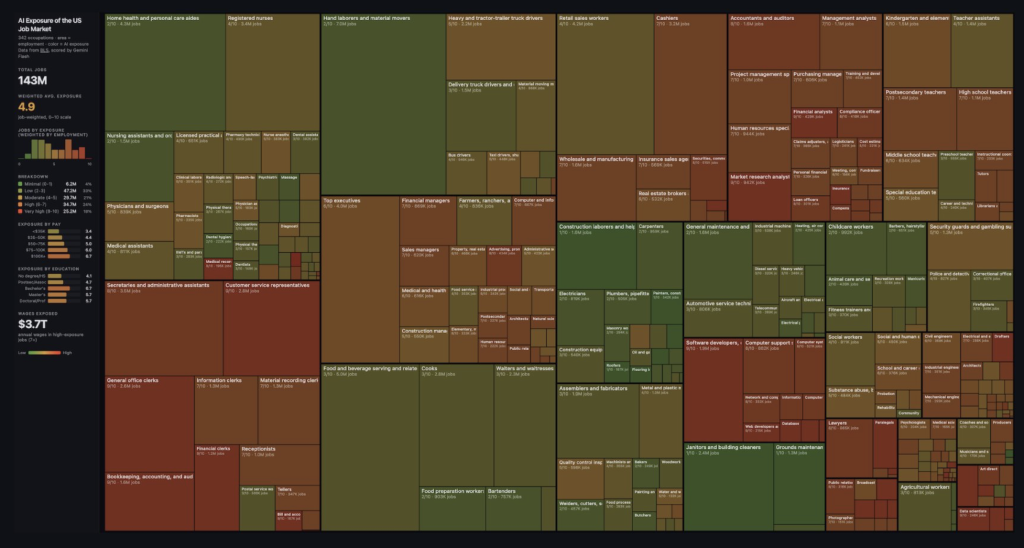
The numbers invert every assumption. Jobs earning over $100,000 scored an average of 6.7 out of 10 for AI exposure. Jobs under $35,000 scored 3.4. The higher your salary, the more exposed you are. Medical transcriptionists scored a perfect 10. Software developers, data scientists, financial analysts, and paralegals all clustered between 8 and 9. Plumbers scored near zero. The trades your guidance counselor warned you about are now the most AI-resistant careers in America.
42% of all occupations scored 7 or higher. That’s 59.9 million workers earning $3.7 trillion in annual wages. The number is so large it’s abstract. But it becomes very concrete when you’re the CFO of a company with 200 knowledge workers averaging $120,000 each, and you realize that half of them scored above 7 on Karpathy’s scale.
The obvious response is to cut. And plenty of companies will. But the best response might be exactly the opposite.
Will Ahmed at Whoop is hiring 600 people right now. Not despite AI productivity gains. Because of them. His logic: when AI drops the cost of execution by 10x, the rational move isn’t to do the same work with fewer people. It’s to do 10x more work. Chase the markets that were too small. Build the features that were too expensive. Run the experiments that didn’t pencil out at human speed. Whoop isn’t optimizing headcount. It’s expanding capacity.
This is the dichotomy every executive faces in 2026. The cost-cutters will post better margins for two quarters. The capacity-expanders will build the businesses that eat the cost-cutters alive by 2028. Same technology. Opposite worldview. As Charlie Munger would say: invert, always invert.
What business leaders need to know: Pull up Karpathy’s list. Find your roles. If half your workforce scores above 7, you have a decision to make this quarter, not next year. But the decision isn’t “who do we fire.” It’s “what couldn’t we do before that we can do now?” The companies that answer that question aggressively will compound the advantage. The ones that default to headcount reduction are optimizing for a spreadsheet, not a strategy.
Pokemon Go Mapped the World. Now the Real AI Race Is Over Who Understands It.

Everyone’s watching the LLM wars. Claude vs. GPT vs. Gemini vs. Grok. Benchmarks, pricing, context windows. It’s the fight that dominates every newsletter, every earnings call, every VC pitch deck. And it might be the wrong fight entirely.
Niantic just revealed what 8 years of Pokemon Go actually built: 30 billion geotagged images from 10 million locations, captured by hundreds of millions of players who thought they were catching Pikachu. Niantic’s spinoff, Niantic Spatial, is now using that data to train a Large Geospatial Model with centimeter-level accuracy. Their first customer: Coco Robotics, deploying delivery bots that understand physical space the way ChatGPT understands English.
This isn’t a niche play. Yann LeCun just launched AMI Labs, his biggest bet yet, to build world models that understand physics, not just language. Fei-Fei Li’s World Labs hit a $5 billion valuation. The thesis: LLMs predict the next token. World models predict the next moment in physical space. If intelligence requires understanding cause and effect in the real world (not just autocompleting sentences), then the entire LLM arms race is fighting the last war.
Which brings us to the companies that should be worried. Start with xAI. Elon Musk just ordered sweeping layoffs, co-founders are leaving, and staff describe the company as “flailing” from constant upheaval. Musk himself admitted xAI needs to be “rebuilt.” The Terafab Project launches in 7 days, but the organizational chaos makes execution questionable. In a Long Form post today, we likened Musk a “human orchestration router.” Even the best router occasionally drops packets.
But the real trouble might be at Meta (NASDAQ: META). Run the ledger. $10 billion on Oculus and the Metaverse (abandoned). A hiring war for elite AI talent that’s failing to retain them. The Alex Wang saga. Massive infrastructure spending that hasn’t translated into a model competitive with Claude or Gemini. And now the Dead Internet problem threatens Meta’s core business: if the engagement their advertisers are paying for is increasingly synthetic, the $130 billion advertising machine starts looking less like a growth engine and more like a house of cards.
Google (NASDAQ: GOOGL) faces similar exposure on YouTube and Search. Are bots watching YouTube? Are bots clicking search results? The honest answer is nobody knows, and the platforms aren’t rushing to find out. But Google has hedges that Meta doesn’t. Gemini is genuinely competitive at the frontier. Google Maps just got conversational AI across 300 million places. Flood prediction, health integration, the Gemini glasses launch. Google’s strategy is clear: embed AI into everything that already has distribution. Meta’s strategy is… spend more.
The bigger picture: The three-horse race in AI isn’t OpenAI vs. Anthropic vs. Google. It’s LLMs vs. world models vs. embedded intelligence. The companies betting on world models (Niantic, LeCun’s AMI Labs, World Labs) might be building the thing that actually matters while everyone else optimizes chatbots. And the companies most exposed (Meta, xAI) are fighting the last war with organizational structures that can’t execute the next one.
What This Means For You
Three forces converged this weekend. The public internet revealed itself as a bot-infested performance with no audience. The white-collar workforce discovered it has a target on its back. And the model race that dominates every headline may be aimed at the wrong finish line.
Audit your ad spend like your CFO’s job depends on it. If you’re buying social media impressions, demand proof of human engagement. The platforms won’t volunteer it. The brands that build their own verification layer (or partner with someone who has) will pay less for more. Everyone else is subsidizing bots.
Decide whether you’re cutting or expanding, and do it this quarter. Karpathy’s scorecard gives you the data. The Whoop playbook gives you the alternative. Don’t split the difference. Half-measures here produce the worst of both worlds: you lose your best people AND miss the expansion window.
Watch the world model space like it’s 1994 and someone just showed you Mosaic. Niantic, AMI Labs, World Labs. These aren’t side projects. They’re bets that the next platform shift isn’t about language at all. If they’re right, the trillion dollars being poured into LLM training runs is the most expensive wrong answer since Kodak doubled down on film.
The winners of 2028 won’t be the companies with the best chatbots. They’ll be the ones who verified their audience was real, expanded when everyone else contracted, and bet on understanding the world instead of just describing it.
Three Questions We Think You Should Be Asking Yourself
What percentage of my digital engagement is actually human, and do I have any way to verify it? Most companies can’t answer this. If your marketing team is reporting engagement metrics from Meta or TikTok, ask them what percentage they can prove came from a human. The silence that follows is the answer. Build verification into your attribution model before the ad market reprices.
If I gave every person on my team an AI copilot tomorrow, what would I build that I can’t build today? This is the Whoop question. Don’t start with “who can I let go.” Start with “what markets, products, or experiments were too expensive to attempt at human speed?” The capacity-expansion companies will be case studies. The cost-cutters will be cautionary tales.
Is my competitive position built on understanding language, or understanding the physical world? If your business depends on logistics, manufacturing, retail, real estate, construction, or anything that exists in physical space, the world model revolution matters more than the next GPT release. LLMs can write your marketing copy. World models can optimize your supply chain. Know which one actually moves your business.
“Humans will retreat to private Discords and chats, watching for signs of bot intrusion. The vast public web will be left to the bots, endlessly speaking to each other about what part of what comment is ‘doing the heavy lifting’ as it turns to a wasteland.”
— Ethan Mollick
— Harry and Anthony
Sources
- Andrej Karpathy’s AI Job Exposure Scoring (342 occupations)
- Ethan Mollick on AI bots overtaking public discourse
- Ethan Mollick on the Dead Internet prediction
- Nate’s Every.to on the 10X expansion thesis
- Whoop hiring 600 people amid AI productivity gains
- Niantic Spatial and Large Geospatial Model
- Yann LeCun launches AMI Labs
- Fei-Fei Li’s World Labs at $5B valuation
- Elon Musk on xAI layoffs and restructuring
- Karpathy on AutoResearch and intelligence brownouts
- Alex Heath visits Anthropic HQ
- Google Maps conversational AI launch
Past Briefings
Everybody Adopted Moneyball. The Edge Lasted Five Years.
THE NUMBER: 10x the individual productivity improvement AI is delivering right now, according to Hebbia CEO George Sivulka. The firm-level productivity improvement? Zero. Same thing happened with electric motors in the 1890s. The gap lasted 30 years. John Henry, the owner of the Boston Red Sox, told Billy Beane something in 2002 that every CEO in America should hear this week: "Anybody who's not tearing their team down right now and rebuilding it using your model, they're dinosaurs. They'll be sitting on their ass on the sofa in October, watching the Boston Red Sox win the World Series." He was...
Mar 11, 2026Karpathy Says Stop Coding. A Fastenal Vending Machine Explains Why He’s Right.
THE NUMBER: $230 billion — the current market cap of Cisco, the company that didn't build websites but built the routing layer that made websites possible. The agent era needs the same thing. Nobody's building it yet. Andrej Karpathy — the man who taught a generation of engineers to build neural networks from scratch through Stanford lectures and YouTube tutorials — just told everyone to stop writing code. Manage the agents that write it for you, he said. The guy who wrote the playbook just rewrote it. This isn't a theoretical shift. The data is proving it right now. Tomasz...
Mar 10, 2026Who Checks the Checker? The correction loop is the most valuable thing in AI right now. Nobody is capturing it.
THE NUMBER: 30x — the productivity multiplier between Boris Cherny, creator of Claude Code, shipping 20-30 PRs per day with five parallel AI instances, and a traditional engineer shipping 3 PRs per week. That's not a rounding error. That's a different species of worker. Three things converged this week that tell a single story — and it's the most important story in AI right now. Karpathy open-sourced autoresearch, a 630-line tool that lets AI agents run 100 ML experiments overnight while you sleep. Shopify's CEO adapted it and got a 19% improvement on first pass. Anthropic shipped Code Review —...