
‘AI mode’ answers questions of how Google wants to win users, says Deepwater’s Gene Munster
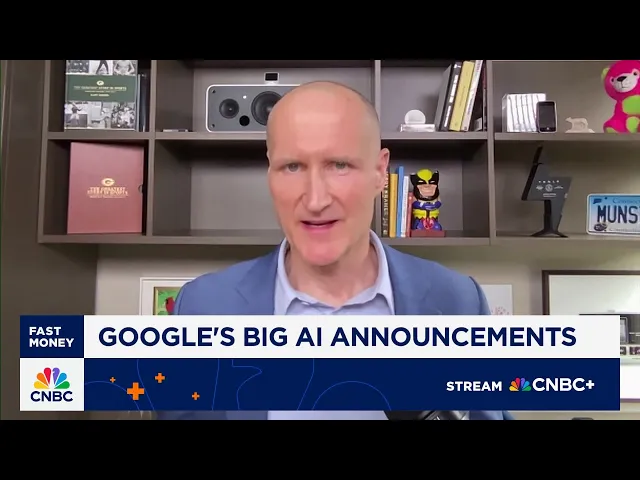
Google's AI mode aims for search dominance
Google's recent launch of its "AI mode" search feature represents the tech giant's latest offensive in the rapidly evolving AI arms race. During a recent CNBC interview, Deepwater Asset Management's Gene Munster offered candid insights into Google's strategic positioning and how this new feature aims to maintain the company's search dominance while fending off Microsoft's Bing and emerging AI threats like ChatGPT. The rollout comes at a critical juncture where Google attempts to blend its traditional search strengths with conversational AI capabilities.
Key elements of Google's AI strategy
-
Google is threading a delicate needle with its AI mode implementation, aiming to enhance search without cannibalizing its primary revenue engine—targeted advertising tied to traditional search results
-
The company faces legitimate competitive pressure from Microsoft's AI-enhanced Bing and OpenAI's ChatGPT, marking the first serious challenge to Google's search dominance in over a decade
-
While the new AI features may improve user experience through summarization and conversational interaction, the fundamental revenue-generating mechanics of Google's business model remain unchanged
The defensive innovation paradox
The most insightful takeaway from Munster's analysis is what I'd call Google's "defensive innovation paradox." Google finds itself in the uncomfortable position of needing to innovate while simultaneously protecting its core business. This isn't just about technology; it's about business model preservation in the face of disruptive change.
The significance of this tension cannot be overstated in today's tech landscape. We're witnessing a classic innovator's dilemma playing out in real-time, where a dominant market leader must respond to potential disruption without undermining its own success. Google generates approximately 80% of its revenue from search advertising, creating powerful institutional resistance to any change that might threaten that income stream, regardless of the long-term strategic benefits.
Beyond the obvious: what the analysis missed
The interview doesn't address how Google's approach to AI differs fundamentally from OpenAI's in terms of risk tolerance. Google has historically been more conservative with AI deployment due to its established brand reputation and regulatory scrutiny. The company's cautious rollout of AI features reflects this institutional culture—prioritizing precision and reliability over cutting-edge capabilities that might introduce errors or
Recent Videos
Hermes Agent Master Class
https://www.youtube.com/watch?v=R3YOGfTBcQg Welcome to the Hermes Agent Master Class — an 11-episode series taking you from zero to fully leveraging every feature of Nous Research's open-source agent. In this first episode, we install Hermes from scratch on a brand new machine with no prior skills or memory, walk through full configuration with OpenRouter, tour the most important CLI and slash commands, and run our first real task: a competitor research report on a custom children's book AI business idea. Every future episode will build on this fresh install so you can see the compounding value of the agent in real time....
Apr 29, 2026Andrej Karpathy – Outsource your thinking, but you can’t outsource your understanding
https://www.youtube.com/watch?v=96jN2OCOfLs Here's what Andrej Karpathy just figured out that everyone else is still dancing around: we're not in an era of "better models." We're in a different era of computing altogether. And the difference between understanding that and not understanding it is the difference between being a vibe coder and being an agentic engineer. Last October, Karpathy had a realization. AI didn't stop being ChatGPT-adjacent. It fundamentally shifted. Agentic coherent workflows started to actually work. And he's spent the last three months living in side projects, VB coding, exploring what's actually possible. What he found is a framework that explains...
Mar 30, 2026Andrej Karpathy on the Decade of Agents, the Limits of RL, and Why Education Is His Next Mission
A summary of key takeaways from Andrej Karpathy's conversation with Dwarkesh Patel In a wide-ranging conversation with Dwarkesh Patel, Andrej Karpathy — former head of AI at Tesla, founding member of OpenAI, and creator of some of the most popular AI educational content on the internet — shared his views on where AI is headed, what's still broken, and why he's now pouring his energy into education. Here are the key takeaways. "It's the Decade of Agents, Not the Year of Agents" Karpathy's now-famous quote is a direct pushback on industry hype. Early agents like Claude Code and Codex are...