
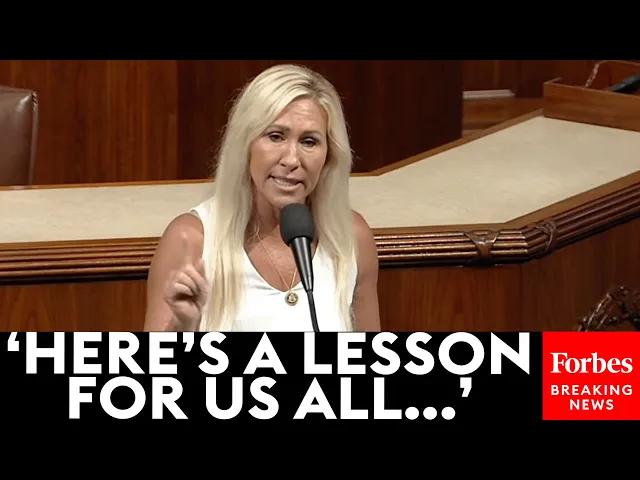
BREAKING NEWS: Marjorie Taylor Greene Demands Senate Pull AI Clause From Trump’s Big, Beautiful Bill
AI politics grows messier by the day
In a stark demonstration of tech policy's growing political volatility, Representative Marjorie Taylor Greene has publicly demanded the Senate remove artificial intelligence provisions from a pending bill championed by former President Trump. This development highlights how AI regulation is rapidly becoming yet another battleground in Washington's increasingly fractious political landscape, with potentially far-reaching consequences for the technology sector.
Key developments worth noting:
- Congressional divisions over AI regulation are intensifying along both partisan and intra-party lines, complicating the path forward for comprehensive legislation
- Trump's apparent support for AI provisions in the bill represents a notable position, potentially at odds with some of his traditional allies
- The specific clause in question appears to center on regulatory frameworks for AI development and deployment, though precise details remain somewhat ambiguous
The shifting sands of tech policy
Perhaps the most striking aspect of this development is how it illustrates the evolving and unpredictable nature of technology policy positions across the political spectrum. Traditional partisan alignments on tech regulation are increasingly giving way to more complex stances that don't neatly follow party lines. This matters tremendously because effective AI governance requires at least some level of policy stability and predictability.
For technology companies navigating this landscape, the implications are significant. The prospect of regulatory whiplash—where approaches to AI oversight might dramatically shift based on which political faction holds power—creates an environment of uncertainty that could ultimately hamper investment and innovation. At the same time, this political fracturing might actually create unexpected opportunities for the tech sector to find allies across traditional divides.
Beyond the headlines
What's particularly interesting about this situation is that it reflects a broader phenomenon unfolding across the global technology policy landscape. While the US debates these issues in Congress, the EU has already implemented its comprehensive AI Act, creating potential regulatory divergence that multinational companies must navigate. China, meanwhile, continues to pursue its own distinctive approach to AI governance.
Consider the case of OpenAI, which has walked a tightrope between embracing responsible innovation guardrails while also pushing technological boundaries. Their experience demonstrates how companies can potentially thrive even amid regulatory uncertainty—by embracing transparency, engaging proactively with policymakers across the spectrum, and building safety considerations into their development process from the ground up.
For business leaders watching these developments, several practical strategies emerge:
Recent Videos
Hermes Agent Master Class
https://www.youtube.com/watch?v=R3YOGfTBcQg Welcome to the Hermes Agent Master Class — an 11-episode series taking you from zero to fully leveraging every feature of Nous Research's open-source agent. In this first episode, we install Hermes from scratch on a brand new machine with no prior skills or memory, walk through full configuration with OpenRouter, tour the most important CLI and slash commands, and run our first real task: a competitor research report on a custom children's book AI business idea. Every future episode will build on this fresh install so you can see the compounding value of the agent in real time....
Apr 29, 2026Andrej Karpathy – Outsource your thinking, but you can’t outsource your understanding
https://www.youtube.com/watch?v=96jN2OCOfLs Here's what Andrej Karpathy just figured out that everyone else is still dancing around: we're not in an era of "better models." We're in a different era of computing altogether. And the difference between understanding that and not understanding it is the difference between being a vibe coder and being an agentic engineer. Last October, Karpathy had a realization. AI didn't stop being ChatGPT-adjacent. It fundamentally shifted. Agentic coherent workflows started to actually work. And he's spent the last three months living in side projects, VB coding, exploring what's actually possible. What he found is a framework that explains...
Mar 30, 2026Andrej Karpathy on the Decade of Agents, the Limits of RL, and Why Education Is His Next Mission
A summary of key takeaways from Andrej Karpathy's conversation with Dwarkesh Patel In a wide-ranging conversation with Dwarkesh Patel, Andrej Karpathy — former head of AI at Tesla, founding member of OpenAI, and creator of some of the most popular AI educational content on the internet — shared his views on where AI is headed, what's still broken, and why he's now pouring his energy into education. Here are the key takeaways. "It's the Decade of Agents, Not the Year of Agents" Karpathy's now-famous quote is a direct pushback on industry hype. Early agents like Claude Code and Codex are...