
China hosts its first fully autonomous AI robot soccer match
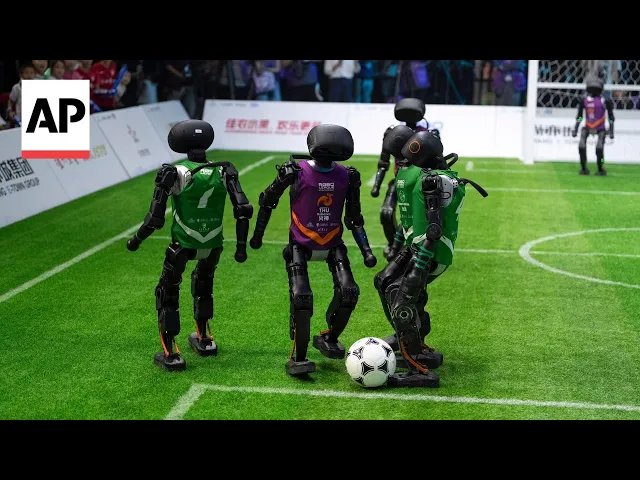
Robot world cup kicks off in China
China has crossed a significant technological threshold with its first fully autonomous robot soccer tournament, showcasing AI capabilities that extend far beyond sports. Held at the Beijing Institute of Technology, the competition featured 32 teams of robots playing without human intervention—a remarkable demonstration of machine learning, computer vision, and real-time decision-making systems working in harmony.
Key Points
- The tournament featured fully autonomous robots making decisions in real-time without human intervention, representing a significant leap in AI technology with applications beyond sports
- Each match was played between teams of child-sized robots, equipped with sensors and cameras that allowed them to identify the ball, track other players, and navigate the field independently
- The competition highlighted China's growing prominence in robotics and AI development, with the country positioning itself as a leader in autonomous systems research
When Robots Play, Humans Learn
What makes this tournament truly remarkable isn't just the novelty of robots playing soccer, but the sophisticated AI architecture working behind the scenes. The most compelling aspect is how these systems integrate multiple technological domains: computer vision to identify the ball and other players, decision-making algorithms to determine optimal positioning and strategies, and mechanical systems to execute movements—all happening in milliseconds.
This integration represents the future of autonomous systems development. While most consumer AI applications today focus on single-domain problems (like generating text or recognizing images), these soccer-playing robots demonstrate how multiple AI systems can work together to solve complex physical challenges in unpredictable environments. This is precisely the kind of integration needed for autonomous vehicles, warehouse robots, and other real-world applications where AI must navigate physical spaces while making rapid decisions.
The tournament also signals China's strategic investment in robotics as a key technological battleground. By showcasing these capabilities in a competitive environment, China is demonstrating its commitment to developing autonomous systems that can operate in complex, changing environments—something that has significant implications for industrial automation, military applications, and consumer technology.
Beyond the Soccer Field
What the video doesn't explore is how similar robot competitions have historically driven technological innovation. The DARPA Grand Challenge for autonomous vehicles, for instance, helped catalyze today's self-driving car industry. Similarly, RoboCup—the international robot soccer tournament—has been pushing robotics research forward since 1997, with many technologies developed for these competitions finding their way into
Recent Videos
Hermes Agent Master Class
https://www.youtube.com/watch?v=R3YOGfTBcQg Welcome to the Hermes Agent Master Class — an 11-episode series taking you from zero to fully leveraging every feature of Nous Research's open-source agent. In this first episode, we install Hermes from scratch on a brand new machine with no prior skills or memory, walk through full configuration with OpenRouter, tour the most important CLI and slash commands, and run our first real task: a competitor research report on a custom children's book AI business idea. Every future episode will build on this fresh install so you can see the compounding value of the agent in real time....
Apr 29, 2026Andrej Karpathy – Outsource your thinking, but you can’t outsource your understanding
https://www.youtube.com/watch?v=96jN2OCOfLs Here's what Andrej Karpathy just figured out that everyone else is still dancing around: we're not in an era of "better models." We're in a different era of computing altogether. And the difference between understanding that and not understanding it is the difference between being a vibe coder and being an agentic engineer. Last October, Karpathy had a realization. AI didn't stop being ChatGPT-adjacent. It fundamentally shifted. Agentic coherent workflows started to actually work. And he's spent the last three months living in side projects, VB coding, exploring what's actually possible. What he found is a framework that explains...
Mar 30, 2026Andrej Karpathy on the Decade of Agents, the Limits of RL, and Why Education Is His Next Mission
A summary of key takeaways from Andrej Karpathy's conversation with Dwarkesh Patel In a wide-ranging conversation with Dwarkesh Patel, Andrej Karpathy — former head of AI at Tesla, founding member of OpenAI, and creator of some of the most popular AI educational content on the internet — shared his views on where AI is headed, what's still broken, and why he's now pouring his energy into education. Here are the key takeaways. "It's the Decade of Agents, Not the Year of Agents" Karpathy's now-famous quote is a direct pushback on industry hype. Early agents like Claude Code and Codex are...