
Googles New AI Glasses Are The Future Of AI (Android XR Update)
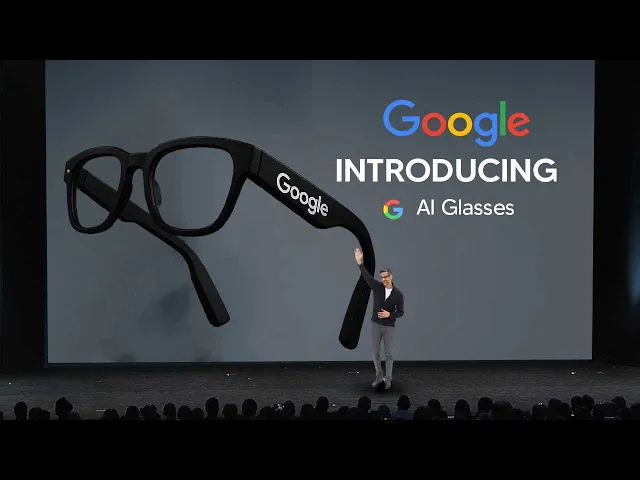
AR glasses that understand what you see
The worlds of augmented reality (AR) and artificial intelligence are converging in ways that could fundamentally transform how we interact with technology. Google's latest innovation in smart glasses, demonstrated at recent tech events, shows how AI can interpret the visual world around us and provide contextual information in real time. Rather than simply overlaying digital elements onto our view, these glasses actively make sense of what we're looking at and respond accordingly.
Key Points
- Google's new AR glasses use multimodal AI to understand the real world through vision and provide contextual information and assistance through audio
- The technology represents a significant shift from earlier AR failures (like Google Glass) by focusing on utility rather than constant visual overlays
- These glasses demonstrate practical applications including language translation, identification of objects and landmarks, and contextual memory assistance
- Google is positioning this as part of a broader Android XR ecosystem that will connect with other devices and extend the Android experience beyond phones
The Breakthrough We've Been Waiting For
The most compelling aspect of Google's approach isn't the hardware itself, but rather how it represents a fundamental rethinking of augmented reality's purpose. Previous attempts at smart glasses, including Google's own Glass experiment, struggled to find the right balance between utility and intrusiveness. Many focused on constant visual overlays that cluttered the user's field of view or created social discomfort.
This new generation takes a different approach by leveraging AI to understand what you're looking at and providing information only when relevant – often through audio rather than visual display. This "ambient computing" model, where technology recedes into the background until needed, aligns with broader industry trends toward more natural human-computer interaction.
In today's business landscape, where information overload is a constant challenge, tools that can filter and contextualize data based on real-world context offer tremendous value. Executives and knowledge workers could potentially benefit from having relevant information appear exactly when needed without the constant distraction of checking devices.
Beyond the Demo: Practical Business Applications
While Google's demonstrations focused on consumer scenarios like translation and landmark identification, the business applications could be far more transformative. Consider a field technician confronted with unfamiliar equipment – these glasses could identify components, access repair manuals, and even connect to remote experts who could see exactly what the technician is seeing.
For
Recent Videos
Hermes Agent Master Class
https://www.youtube.com/watch?v=R3YOGfTBcQg Welcome to the Hermes Agent Master Class — an 11-episode series taking you from zero to fully leveraging every feature of Nous Research's open-source agent. In this first episode, we install Hermes from scratch on a brand new machine with no prior skills or memory, walk through full configuration with OpenRouter, tour the most important CLI and slash commands, and run our first real task: a competitor research report on a custom children's book AI business idea. Every future episode will build on this fresh install so you can see the compounding value of the agent in real time....
Apr 29, 2026Andrej Karpathy – Outsource your thinking, but you can’t outsource your understanding
https://www.youtube.com/watch?v=96jN2OCOfLs Here's what Andrej Karpathy just figured out that everyone else is still dancing around: we're not in an era of "better models." We're in a different era of computing altogether. And the difference between understanding that and not understanding it is the difference between being a vibe coder and being an agentic engineer. Last October, Karpathy had a realization. AI didn't stop being ChatGPT-adjacent. It fundamentally shifted. Agentic coherent workflows started to actually work. And he's spent the last three months living in side projects, VB coding, exploring what's actually possible. What he found is a framework that explains...
Mar 30, 2026Andrej Karpathy on the Decade of Agents, the Limits of RL, and Why Education Is His Next Mission
A summary of key takeaways from Andrej Karpathy's conversation with Dwarkesh Patel In a wide-ranging conversation with Dwarkesh Patel, Andrej Karpathy — former head of AI at Tesla, founding member of OpenAI, and creator of some of the most popular AI educational content on the internet — shared his views on where AI is headed, what's still broken, and why he's now pouring his energy into education. Here are the key takeaways. "It's the Decade of Agents, Not the Year of Agents" Karpathy's now-famous quote is a direct pushback on industry hype. Early agents like Claude Code and Codex are...