
Lost Your Job to AI? Here’s How to Stay Ahead | Vantage with Palki Sharma
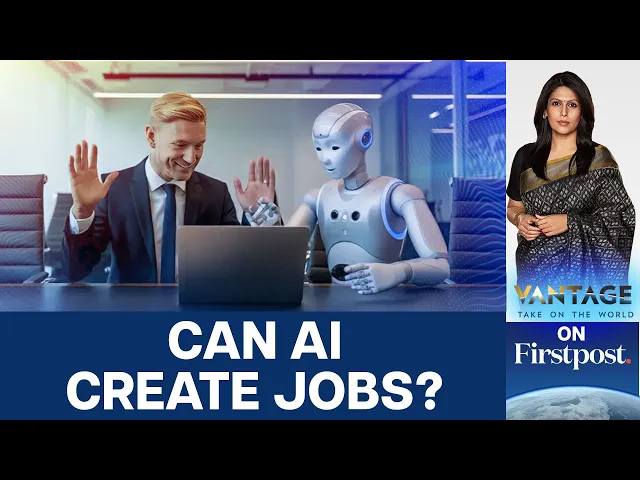
Job security in the age of AI
In the rapidly evolving landscape of artificial intelligence, workers across industries face an existential question: will AI take my job? Palki Sharma's video tackles this pressing concern, exploring how AI is reshaping employment while offering perspective on how humans can adapt and thrive. Understanding this technological shift isn't just about survival—it's about reimagining our relationship with work itself.
Key insights from the discussion:
- AI is transforming jobs across sectors—from traditional manufacturing to creative and knowledge work—but typically augments rather than completely replaces human workers
- The technology creates a "barbell effect" in employment: eliminating middle-skilled jobs while creating opportunities at both ends of the skill spectrum
- Adaptation requires developing distinctly human skills that AI cannot easily replicate: creativity, emotional intelligence, ethical judgment, and complex problem-solving
The human advantage in an AI world
The most compelling insight from Sharma's analysis is that our most "human" attributes remain our greatest competitive advantage. While AI excels at processing vast amounts of data and identifying patterns, it fundamentally lacks human intuition, ethical reasoning, and emotional intelligence. This creates a clear pathway for workers: lean into skills that machines cannot easily replicate.
This matters tremendously in our current economic context. As companies rapidly deploy AI solutions to cut costs and boost productivity, the market increasingly rewards those who can work alongside these systems while providing uniquely human value. The workers who thrive won't be those fighting against automation but those who position themselves at the intersection of technological capability and human insight.
Beyond the video: The nuanced reality of AI adoption
What Sharma's analysis doesn't fully explore is how unevenly AI adoption is occurring across different industries and regions. In healthcare, for instance, AI tools are transforming diagnostic processes but implementation varies dramatically between large urban hospitals and rural clinics. A radiologist in a major medical center might already work alongside AI tools that flag potential issues in scans, while their counterpart in a small-town practice might still rely entirely on human expertise.
This uneven adoption creates both challenges and opportunities. Workers in rapidly transforming sectors face more immediate pressure to adapt, but also gain early experience with human-AI collaboration that may prove valuable across industries. Meanwhile, those in sectors with slower AI integration have more time to prepare but risk falling behind on crucial skills
Recent Videos
Hermes Agent Master Class
https://www.youtube.com/watch?v=R3YOGfTBcQg Welcome to the Hermes Agent Master Class — an 11-episode series taking you from zero to fully leveraging every feature of Nous Research's open-source agent. In this first episode, we install Hermes from scratch on a brand new machine with no prior skills or memory, walk through full configuration with OpenRouter, tour the most important CLI and slash commands, and run our first real task: a competitor research report on a custom children's book AI business idea. Every future episode will build on this fresh install so you can see the compounding value of the agent in real time....
Apr 29, 2026Andrej Karpathy – Outsource your thinking, but you can’t outsource your understanding
https://www.youtube.com/watch?v=96jN2OCOfLs Here's what Andrej Karpathy just figured out that everyone else is still dancing around: we're not in an era of "better models." We're in a different era of computing altogether. And the difference between understanding that and not understanding it is the difference between being a vibe coder and being an agentic engineer. Last October, Karpathy had a realization. AI didn't stop being ChatGPT-adjacent. It fundamentally shifted. Agentic coherent workflows started to actually work. And he's spent the last three months living in side projects, VB coding, exploring what's actually possible. What he found is a framework that explains...
Mar 30, 2026Andrej Karpathy on the Decade of Agents, the Limits of RL, and Why Education Is His Next Mission
A summary of key takeaways from Andrej Karpathy's conversation with Dwarkesh Patel In a wide-ranging conversation with Dwarkesh Patel, Andrej Karpathy — former head of AI at Tesla, founding member of OpenAI, and creator of some of the most popular AI educational content on the internet — shared his views on where AI is headed, what's still broken, and why he's now pouring his energy into education. Here are the key takeaways. "It's the Decade of Agents, Not the Year of Agents" Karpathy's now-famous quote is a direct pushback on industry hype. Early agents like Claude Code and Codex are...