
Microsoft Accidentally Created the Most Efficient AI Ever
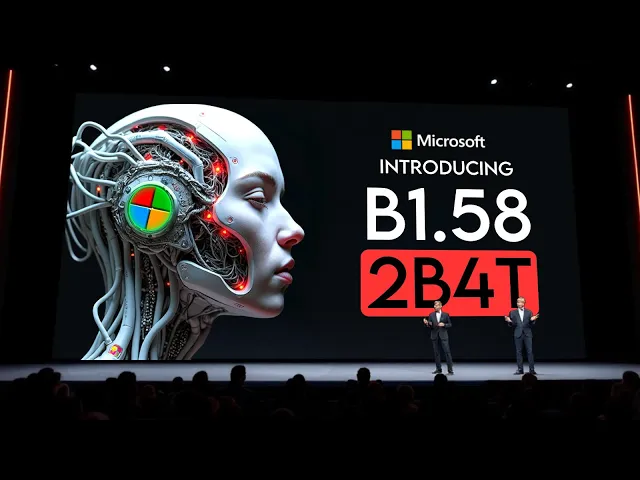
1.58-bit miracle: Microsoft's tiny AI revolution
Microsoft researchers have quietly upended the AI efficiency game with their latest creation: BitNet B1.58. In a landscape dominated by power-hungry models requiring specialized hardware, this innovation represents a fundamental rethinking of how AI can operate within extreme constraints. Rather than following the typical path of building large models that later get compressed, Microsoft's team started with radical limitations and still produced impressive results.
Key Points:
-
Radical compression approach: BitNet uses only three possible values for weights (-1, 0, +1), averaging 1.58 bits per parameter, compared to traditional models using 16 or 32 bits.
-
Trained from scratch with constraints: Unlike most quantized models that start as full-precision and get compressed later, BitNet was built to work with these limitations from day one.
-
Remarkable efficiency gains: The model delivers 85-96% lower energy consumption while maintaining competitive accuracy across benchmarks, outperforming similarly-sized models in reasoning tasks.
-
Desktop-class hardware compatibility: With a memory footprint of just 0.4GB (versus 2-5GB for comparable models), BitNet runs effectively on CPUs and fits within modern processor cache structures.
The True Revolution: Native Low-Bit Training
What makes BitNet truly revolutionary isn't just its small size, but its approach to development. Most compact AI models suffer from what AI researchers call the "quantization gap" – the performance drop when converting a high-precision model to a low-precision one. Microsoft's team eliminated this gap by embracing constraints from the beginning.
This matters enormously for the broader industry. As AI deployment expands beyond data centers to personal devices, energy efficiency and hardware compatibility become crucial barriers. BitNet suggests we don't need to sacrifice intelligence for accessibility – we just need to rethink our approach to model architecture from first principles.
Beyond the Research Paper
Microsoft's work connects to a broader historical pattern in computing. The early days of computing saw remarkable innovation under extreme hardware constraints – from the Apollo Guidance Computer to early video games that squeezed impressive performance from minimal hardware. Then came decades of reliance on Moore's Law, where we solved problems by waiting for faster hardware. BitNet represents a return to constraints-based innovation.
Recent Videos
Andrej Karpathy on the Decade of Agents, the Limits of RL, and Why Education Is His Next Mission
A summary of key takeaways from Andrej Karpathy's conversation with Dwarkesh Patel In a wide-ranging conversation with Dwarkesh Patel, Andrej Karpathy — former head of AI at Tesla, founding member of OpenAI, and creator of some of the most popular AI educational content on the internet — shared his views on where AI is headed, what's still broken, and why he's now pouring his energy into education. Here are the key takeaways. "It's the Decade of Agents, Not the Year of Agents" Karpathy's now-famous quote is a direct pushback on industry hype. Early agents like Claude Code and Codex are...
Oct 6, 2025How To Earn MONEY With Images (No Bullsh*t)
Smart earnings from your image collection In today's digital economy, passive income streams have become increasingly accessible to creators with various skill sets. A recent YouTube video cuts through the hype to explore legitimate ways photographers, designers, and even casual smartphone users can monetize their image collections. The strategies outlined don't rely on unrealistic promises or complicated schemes—instead, they focus on established marketplaces with proven revenue potential for image creators. Key Points Stock photography platforms like Shutterstock, Adobe Stock, and Getty Images remain viable income sources when you understand their specific requirements and optimize your submissions accordingly. Specialized marketplaces focusing...
Oct 3, 2025New SHAPE SHIFTING AI Robot Is Freaking People Out
Liquid robots will change everything In the quiet labs of Carnegie Mellon University, scientists have created something that feels plucked from science fiction—a magnetic slime robot that can transform between liquid and solid states, slipping through tight spaces before reassembling on the other side. This technology, showcased in a recent YouTube video, represents a significant leap beyond traditional robotics into a realm where machines mimic not just animal movements, but their fundamental physical properties. While the internet might be buzzing with dystopian concerns about "shape-shifting terminators," the reality offers far more promising applications that could revolutionize medicine, rescue operations, and...