
My 3-Part Workflow to Stand Out In Academia (Keep it simple)
# My 3-Part Workflow to Stand Out In Academia (A Simple Approach)
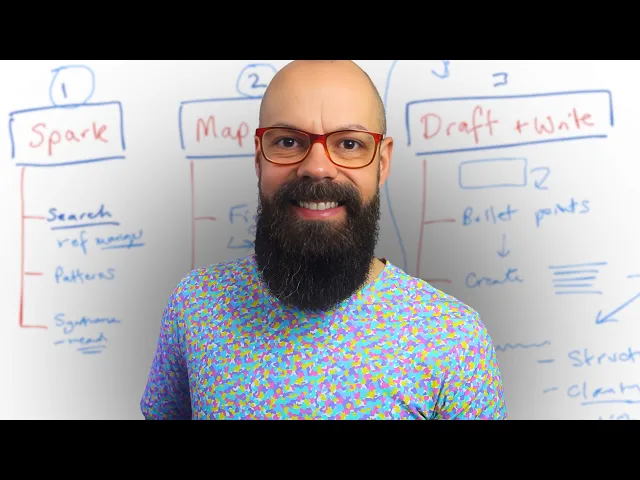
In academia, working harder isn’t always the answer to publishing faster or standing out. Many researchers waste time on activities that don’t move their work forward significantly. The key is to establish efficient workflows that maximize output while minimizing distractions. Here’s a powerful three-part workflow system that can transform your academic productivity.
## Workflow 1: Spark – Generating Ideas Continuously
When you feel lost or uninspired in your research, this workflow helps reignite your creativity:
1. **Search** regularly for research ideas around your main topic
– Use tools like Google Scholar, Open Alex, or AI tools like Elicit to get summaries of top papers
– Stay at the leading edge of research in your field
2. **Save** all references to your reference manager (Zotero, Mendeley, EndNote)
3. **Synthesize** to find patterns in the research
– Read abstracts to understand each paper
– Use tools like Notebook LM to upload sources and chat with your reference list
– Delve deeper into interesting papers
– Read extensively on topics that spark your interest
**Pro tip:** Run this workflow whenever you feel uninspired. It also gives you valuable information to share in supervisor meetings—starting conversations with “I was reading an interesting paper recently…” makes you stand out as a valuable source of information.
## Workflow 2: Map and Frame – Turning Data into Stories
Once you have data, this workflow helps transform it into compelling research narratives:
1. **Create figures** as you collect data
– Don’t procrastinate on analysis—do it the same day or next day
– Each figure should tell a clear story that you can explain
2. **Draw conclusions** from individual figures
3. **Craft research stories** by combining multiple figures
– Identify the problem you’re solving
– Present the evidence from your figures
– Highlight the outcome and its importance
– Keep your big reveals simple (one or two main points)
4. **Tell people** about your research regularly
– Present at departmental symposia or research group meetings
– Speaking about your research helps you identify gaps
– Explaining to others
Recent Videos
Andrej Karpathy on the Decade of Agents, the Limits of RL, and Why Education Is His Next Mission
A summary of key takeaways from Andrej Karpathy's conversation with Dwarkesh Patel In a wide-ranging conversation with Dwarkesh Patel, Andrej Karpathy — former head of AI at Tesla, founding member of OpenAI, and creator of some of the most popular AI educational content on the internet — shared his views on where AI is headed, what's still broken, and why he's now pouring his energy into education. Here are the key takeaways. "It's the Decade of Agents, Not the Year of Agents" Karpathy's now-famous quote is a direct pushback on industry hype. Early agents like Claude Code and Codex are...
Oct 6, 2025How To Earn MONEY With Images (No Bullsh*t)
Smart earnings from your image collection In today's digital economy, passive income streams have become increasingly accessible to creators with various skill sets. A recent YouTube video cuts through the hype to explore legitimate ways photographers, designers, and even casual smartphone users can monetize their image collections. The strategies outlined don't rely on unrealistic promises or complicated schemes—instead, they focus on established marketplaces with proven revenue potential for image creators. Key Points Stock photography platforms like Shutterstock, Adobe Stock, and Getty Images remain viable income sources when you understand their specific requirements and optimize your submissions accordingly. Specialized marketplaces focusing...
Oct 3, 2025New SHAPE SHIFTING AI Robot Is Freaking People Out
Liquid robots will change everything In the quiet labs of Carnegie Mellon University, scientists have created something that feels plucked from science fiction—a magnetic slime robot that can transform between liquid and solid states, slipping through tight spaces before reassembling on the other side. This technology, showcased in a recent YouTube video, represents a significant leap beyond traditional robotics into a realm where machines mimic not just animal movements, but their fundamental physical properties. While the internet might be buzzing with dystopian concerns about "shape-shifting terminators," the reality offers far more promising applications that could revolutionize medicine, rescue operations, and...