
Optimizing inference for voice models in production
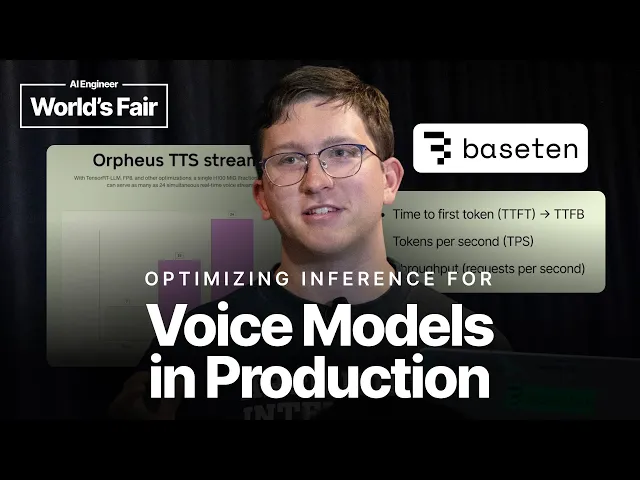
Voice AI in production: optimizing for scale
The expanding universe of voice AI in production environments presents a fascinating blend of challenges and opportunities. Philip Kiely's recent presentation on optimizing inference for voice models offers a compelling blueprint for companies implementing these technologies at scale. As businesses increasingly incorporate voice interfaces into their products, understanding the technical infrastructure required becomes not just beneficial but essential.
Voice models represent one of the most computationally intensive aspects of modern AI systems, yet their implementation details often remain obscured behind technical complexity. The journey from model development to production deployment involves navigating a landscape of hardware constraints, latency requirements, and cost considerations that can make or break a voice-enabled product's success.
Key points from the presentation:
-
Voice models require significant computational resources, with requirements jumping from consumer-grade GPUs during development to more sophisticated infrastructure in production environments.
-
Effective inference optimization involves finding the right balance between model quality, speed, and cost—often requiring both technical strategies like quantization and business decisions about acceptable trade-offs.
-
The implementation pipeline typically follows a pattern of preprocessing audio inputs, running the model, and post-processing outputs—each stage offering optimization opportunities.
-
Voice AI systems benefit from horizontal scaling approaches that distribute work across multiple servers, particularly important as user traffic grows.
-
Modern deployment strategies often involve containerization, orchestration, and specialized hardware acceleration to achieve optimal performance.
The hidden complexity of voice AI optimization
What stands out most from this presentation is the stark contrast between the seemingly simple user experience of voice interfaces and the remarkable complexity happening behind the scenes. This represents the true challenge of production voice AI: creating systems that handle enormous computational loads while maintaining the illusion of effortless interaction.
This matters tremendously in today's AI landscape because voice interfaces are rapidly becoming ubiquitous entry points to technology. From virtual assistants to transcription services and beyond, user expectations for response speed and accuracy continue to rise while businesses face pressure to control infrastructure costs. The organizations that master this balancing act gain significant competitive advantages in user experience and operational efficiency.
Beyond the presentation: real-world implications
What's particularly interesting about voice model optimization is how the technical choices cascade into business outcomes. Consider Spotify's voice search feature, which initially suffered from latency issues that damaged user engagement. Their engineering team ultimately redesigned their inference pipeline with many of the principles Kiely
Recent Videos
Hermes Agent Master Class
https://www.youtube.com/watch?v=R3YOGfTBcQg Welcome to the Hermes Agent Master Class — an 11-episode series taking you from zero to fully leveraging every feature of Nous Research's open-source agent. In this first episode, we install Hermes from scratch on a brand new machine with no prior skills or memory, walk through full configuration with OpenRouter, tour the most important CLI and slash commands, and run our first real task: a competitor research report on a custom children's book AI business idea. Every future episode will build on this fresh install so you can see the compounding value of the agent in real time....
Apr 29, 2026Andrej Karpathy – Outsource your thinking, but you can’t outsource your understanding
https://www.youtube.com/watch?v=96jN2OCOfLs Here's what Andrej Karpathy just figured out that everyone else is still dancing around: we're not in an era of "better models." We're in a different era of computing altogether. And the difference between understanding that and not understanding it is the difference between being a vibe coder and being an agentic engineer. Last October, Karpathy had a realization. AI didn't stop being ChatGPT-adjacent. It fundamentally shifted. Agentic coherent workflows started to actually work. And he's spent the last three months living in side projects, VB coding, exploring what's actually possible. What he found is a framework that explains...
Mar 30, 2026Andrej Karpathy on the Decade of Agents, the Limits of RL, and Why Education Is His Next Mission
A summary of key takeaways from Andrej Karpathy's conversation with Dwarkesh Patel In a wide-ranging conversation with Dwarkesh Patel, Andrej Karpathy — former head of AI at Tesla, founding member of OpenAI, and creator of some of the most popular AI educational content on the internet — shared his views on where AI is headed, what's still broken, and why he's now pouring his energy into education. Here are the key takeaways. "It's the Decade of Agents, Not the Year of Agents" Karpathy's now-famous quote is a direct pushback on industry hype. Early agents like Claude Code and Codex are...