
This New AI Could Be the First Real ARTIFICIAL BRAIN!
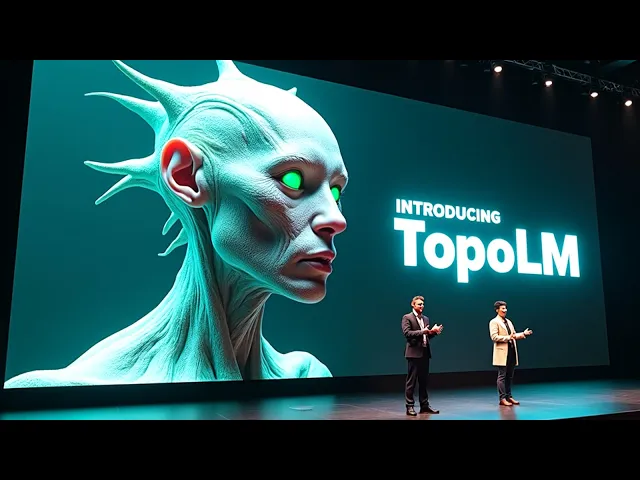
Artificial brain: a language model that learns like you
Imagine a language model that doesn't just predict your next word, but actually builds organized neural maps like a human brain. That's what researchers at EPFL's neuroAI laboratory in Switzerland have achieved with their new Topographic Language Model (Topo LM). This breakthrough AI doesn't just mimic human language—it mimics how our brains physically structure language processing.
Key Points
-
Topo LM organizes its artificial neurons on a grid where physically nearby neurons develop similar functions—mirroring how human brains form specialized regions for different language tasks.
-
The model uses a simple "keep nearby neurons similar" rule that creates emergent structure: distinct regions for nouns, verbs, and various language functions appear naturally during training.
-
Unlike standard language models with scattered, unorganized neurons, Topo LM maintains nearly identical performance while gaining interpretability—you can literally point to a "verb region" or "noun region" on its neural map.
-
Researchers verified the model's brain-like properties by testing it against actual fMRI data of human brains processing language, finding remarkable similarities in how both organize language information.
Expert Analysis: Biology and AI Are Converging
The most significant insight from this research isn't just that we can make AI more brain-like—it's that we might have discovered a universal organizing principle that applies across cognitive domains. The same "wiring cost" principle that explains visual processing organization in the brain now appears to work for language too, despite language being far more abstract.
This convergence matters tremendously for the AI industry, which has long faced a tradeoff between performance and interpretability. Topo LM demonstrates we can potentially have both: powerful language processing with naturally organized, inspectable structure. As large language models become increasingly embedded in our digital infrastructure, having models whose internal workings we can actually map and understand offers a path toward more trustworthy and auditable AI systems.
Opening New Doors for AI and Neuroscience
What the video doesn't fully explore is how this approach might revolutionize multimodal AI systems. Current multimodal models like GPT-4V or Gemini struggle with grounding—truly connecting language to visual concepts. A topographic approach could potentially create natural bridges between
Recent Videos
Andrej Karpathy on the Decade of Agents, the Limits of RL, and Why Education Is His Next Mission
A summary of key takeaways from Andrej Karpathy's conversation with Dwarkesh Patel In a wide-ranging conversation with Dwarkesh Patel, Andrej Karpathy — former head of AI at Tesla, founding member of OpenAI, and creator of some of the most popular AI educational content on the internet — shared his views on where AI is headed, what's still broken, and why he's now pouring his energy into education. Here are the key takeaways. "It's the Decade of Agents, Not the Year of Agents" Karpathy's now-famous quote is a direct pushback on industry hype. Early agents like Claude Code and Codex are...
Oct 6, 2025How To Earn MONEY With Images (No Bullsh*t)
Smart earnings from your image collection In today's digital economy, passive income streams have become increasingly accessible to creators with various skill sets. A recent YouTube video cuts through the hype to explore legitimate ways photographers, designers, and even casual smartphone users can monetize their image collections. The strategies outlined don't rely on unrealistic promises or complicated schemes—instead, they focus on established marketplaces with proven revenue potential for image creators. Key Points Stock photography platforms like Shutterstock, Adobe Stock, and Getty Images remain viable income sources when you understand their specific requirements and optimize your submissions accordingly. Specialized marketplaces focusing...
Oct 3, 2025New SHAPE SHIFTING AI Robot Is Freaking People Out
Liquid robots will change everything In the quiet labs of Carnegie Mellon University, scientists have created something that feels plucked from science fiction—a magnetic slime robot that can transform between liquid and solid states, slipping through tight spaces before reassembling on the other side. This technology, showcased in a recent YouTube video, represents a significant leap beyond traditional robotics into a realm where machines mimic not just animal movements, but their fundamental physical properties. While the internet might be buzzing with dystopian concerns about "shape-shifting terminators," the reality offers far more promising applications that could revolutionize medicine, rescue operations, and...