
Google DeepMind’s Veo 3 is mindblowing.
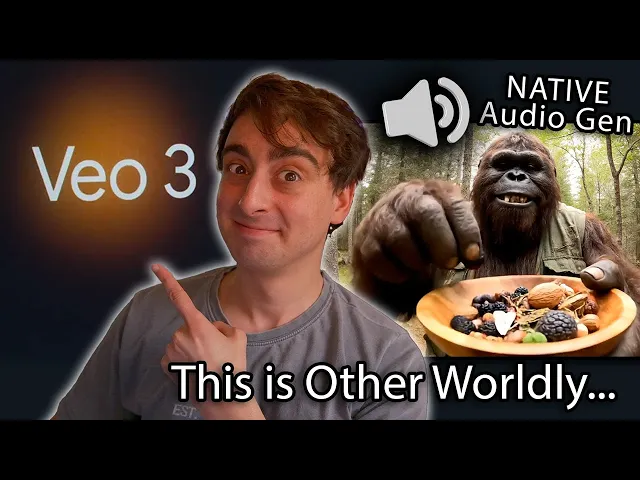
AI's quantum leap elevates creative work
In a recent demo that left even tech veterans wide-eyed, Google unveiled Veo 3—a video generation AI model that might just redefine what's possible in digital content creation. This advancement doesn't just incrementally improve on previous technology; it represents a fundamental shift in how AI can translate text into remarkably accurate, coherent visual narratives. Let's explore why this matters to businesses and creative professionals alike.
The demonstration showcased Veo 3's ability to generate sophisticated videos from simple text prompts, displaying a level of understanding and execution that feels unnervingly human. The presenter's excitement wasn't just marketing hype—the technology demonstrates capabilities that were science fiction just months ago. What we're witnessing is the emergence of AI that doesn't just assist creative work but potentially transforms entire workflows.
The key revelations from the Veo 3 demonstration include:
-
Unprecedented scene consistency where AI maintains visual coherence throughout generated videos, keeping characters, settings, and objects consistent—a previous limitation that made earlier AI videos feel disjointed and unrealistic.
-
Remarkable prompt comprehension with the system actually understanding complex instructions and nuanced creative direction, rather than producing literal or misinterpreted interpretations that plagued earlier models.
-
Production-ready visual quality that approaches professional standards, with lighting, composition, and movement that demonstrate genuine cinematic awareness rather than the uncanny, distorted outputs common in previous generations.
The most profound insight from this demonstration isn't just the technical achievement—it's the implications for creative work. Veo 3 represents a transition point where AI stops being merely a curiosity or limited tool and begins functioning as a genuine creative partner. This shift matters because it fundamentally changes the economics and possibilities of visual storytelling across industries.
For businesses, this development means that content creation—previously constrained by production costs, technical expertise requirements, and time limitations—suddenly becomes accessible at scale. Small marketing teams can now potentially produce cinematic-quality content without massive budgets or specialized staff. The barriers to entry for visual communication are collapsing in real-time.
What the demonstration didn't address, however, is how these capabilities might reshape creative careers. Unlike previous technological disruptions that primarily affected standardized or repetitive work, Veo 3 operates
Recent Videos
Hermes Agent Master Class
https://www.youtube.com/watch?v=R3YOGfTBcQg Welcome to the Hermes Agent Master Class — an 11-episode series taking you from zero to fully leveraging every feature of Nous Research's open-source agent. In this first episode, we install Hermes from scratch on a brand new machine with no prior skills or memory, walk through full configuration with OpenRouter, tour the most important CLI and slash commands, and run our first real task: a competitor research report on a custom children's book AI business idea. Every future episode will build on this fresh install so you can see the compounding value of the agent in real time....
Apr 29, 2026Andrej Karpathy – Outsource your thinking, but you can’t outsource your understanding
https://www.youtube.com/watch?v=96jN2OCOfLs Here's what Andrej Karpathy just figured out that everyone else is still dancing around: we're not in an era of "better models." We're in a different era of computing altogether. And the difference between understanding that and not understanding it is the difference between being a vibe coder and being an agentic engineer. Last October, Karpathy had a realization. AI didn't stop being ChatGPT-adjacent. It fundamentally shifted. Agentic coherent workflows started to actually work. And he's spent the last three months living in side projects, VB coding, exploring what's actually possible. What he found is a framework that explains...
Mar 30, 2026Andrej Karpathy on the Decade of Agents, the Limits of RL, and Why Education Is His Next Mission
A summary of key takeaways from Andrej Karpathy's conversation with Dwarkesh Patel In a wide-ranging conversation with Dwarkesh Patel, Andrej Karpathy — former head of AI at Tesla, founding member of OpenAI, and creator of some of the most popular AI educational content on the internet — shared his views on where AI is headed, what's still broken, and why he's now pouring his energy into education. Here are the key takeaways. "It's the Decade of Agents, Not the Year of Agents" Karpathy's now-famous quote is a direct pushback on industry hype. Early agents like Claude Code and Codex are...